The Architecture of Dread: Building Atmospheric Tension Before a Single Word Is Spoken

Why the Room Does Half the Work
Most performers walk into a venue and start thinking about their opening line. The serious ones arrive two hours early and start thinking about the air.
Atmospheric work is not decoration. It is not mood-setting in the theatrical sense, where lighting and set dressing support a story already written. In bizarre magic and mentalism, the atmosphere is the first act. By the time you speak your opening sentence, the audience should already be unsettled. They should not be able to explain why.
This is a learnable skill, repeatable, and entirely separate from your scripted material. What follows is a working framework for building genuine psychological tension before a single word of performance has been delivered.
Light as an Instrument, Not a Fixture

Stage lighting is designed to make performers visible. Séance lighting is designed to make everything else uncertain.
The distinction matters. If your venue has a dimmer board, resist the temptation to simply lower the house lights to “atmospheric.” That produces darkness, not dread. Dread comes from selectivity: what is lit, what is shadowed, and where the eye keeps returning without finding resolution.
Practical light sources do this better than theatrical instruments in most intimate settings. A single oil lamp on a side table. A pair of candles at the far end of the room, positioned just beyond comfortable focus. One directional source that illuminates a prop without fully explaining it. The audience brain fills gaps. You want it busy filling gaps before you have said anything.
Color temperature matters more than most performers account for. Warm amber sources, around 2000-2200K, consistent with candlelight, read as old. They pull the room out of the present tense. Cool sources feel clinical; they work against you in a séance context unless you are deliberately building a paranormal investigation aesthetic. Know which world you are constructing before you choose your sources.
One practical note: never let all sources sit at eye level or below. A small upward-facing light placed behind an object casts its shadow onto the ceiling and walls. Shadows that move upward register as wrong. Use that.
Ambient Sound and the Grammar of Silence
Sound design for bizarre magic divides into two categories: what you play, and what you do not.
On the ambient side, the common mistake is choosing tracks that read as obviously “spooky.” Drone music, minor-key string clusters, anything that signals horror film. Genre signals safety. Safety is the opposite of what you want.
The more effective approach uses sound that is almost right. A field recording with one element that does not belong. A piece of early 20th-century phonograph music played slightly below normal speed. The sound of a building at night, with one creak that does not repeat on a predictable interval. The brain cannot habituate to irregular stimuli. It stays alert.
Volume is critical. The level should sit just below conversational speech. Guests will unconsciously lower their own voices to match. Quieter voices produce quieter bodies. Quieter bodies are more receptive, more focused, and significantly easier to direct.
On silence: learn to use it before you enter the room. If you have any control over the pre-show environment, build in a period of complete quiet before your arrival. Two minutes of ambient sound, then it stops. Then you enter. The contrast between ambient noise and silence reads as the approach of something. You become the thing that arrives after the sound stops.
The Grammar of Objects: Prop Placement Before the Show
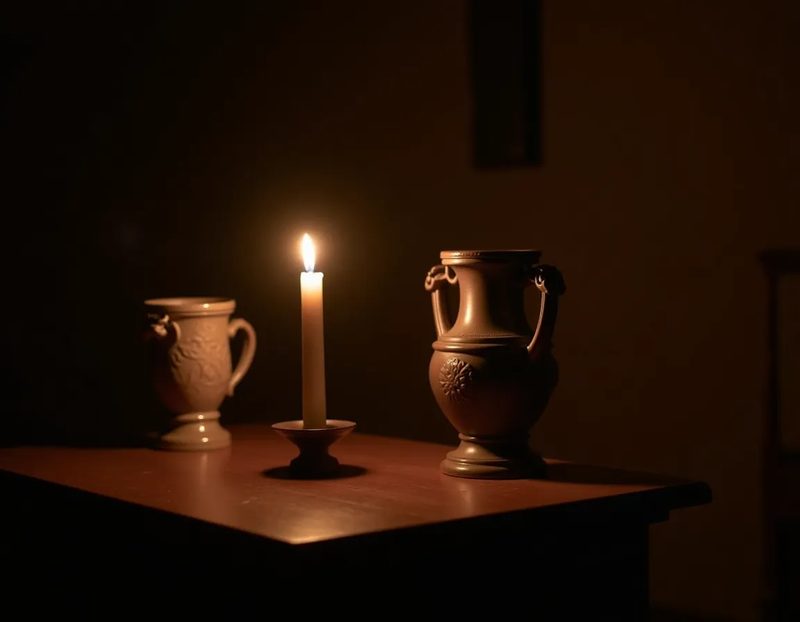
Every object visible in your performance space before the show starts is making an argument. The argument is: something is going to happen here.
Prop placement is not prop display. Display arranges things to look good. Placement arranges things to create questions. There is a significant difference.
Consider the single, face-down playing card on an otherwise clear table. No deck in sight. No explanation. It was there when guests arrived. The card may mean nothing in the performance, and it does not matter. Its job was to put the question in the room.
Objects work best when placed at the edges of comfortable attention. Not centerpiece placement, not hidden; somewhere between. A pocket watch beside a chair nobody sits in. A closed book spine-out on a shelf, with a slip of paper protruding from its pages. A single glove. These items function as visual subordinate clauses. They suggest that a sentence is coming.
Avoid clutter. Three or four deliberate objects accomplish more than a full table of props. The brain treats abundance as decoration. Scarcity creates attention.
Asymmetry is your ally. Symmetrical arrangements read as controlled and designed, which is comforting. Slight asymmetry, the object that is almost but not quite aligned with its neighbors, reads as something interrupted. Something arranged by someone who was then called away.
The Pre-Show Encounter: Misdirection Before You Begin
If you have access to your audience before the formal performance begins, you have the most powerful pre-show tool available: live contact.
This does not mean performing. It does not mean doing effects in the lobby. It means controlled encounter design that plants material and primes psychology without being identifiable as performance.
The simplest version: you are present in the space as guests arrive, apparently occupied with something else. Examining an object, making a note, consulting a document. You do not immediately acknowledge the room. When you do make contact, it is brief. You learn one thing about one person, a name, a detail they volunteer, and you move on. That detail may or may not reappear in the performance. It does not matter either way. What matters is that every person in the room now holds a small, private uncertainty about what you know and when you learned it.
For seated séance work: the waiting period before guests are invited into the performance space is not dead time. If you can pipe your ambient sound into the waiting area at lower volume, do it. If your materials reference an absent third party, a medium, a deceased subject, a previous participant, refer to that person casually in pre-show conversation. “She left a note about this evening.” Do not explain it. Move on.
Annemann understood the value of the pre-show period and addressed it directly in Practical Mental Effects. Banachek’s Psychosomatic Mentalism contains sharp observations on managing the room before formal performance begins. The literature on this specific area is not extensive, but it exists. Read it carefully.
Pacing, Arrival, and the Productive Use of Waiting
The moment you enter the performance space is the first moment of the show. Most performers waste it by entering normally.
“Normally” means: the performer walks in, perhaps says hello, moves to their position, and begins. The audience has been given no reason to shift attention modes. They are still in receiving-information mode. That is not where you want them.
The alternative is to treat your entrance as a cue that something has changed. The change can be very small. You enter and do not immediately acknowledge the room. You stand at a position for a count of three before turning. You sit without speaking and adjust one object on the table before you look up. These behaviors are not theatrical in the dramatic sense. They are simply not normal. “Not normal” is the perceptual key you are looking for.
Pacing throughout the pre-show should be slower than feels comfortable. Silence should last longer than feels comfortable. The audience’s discomfort with silence is yours to use. When nobody speaks and nothing happens, attention increases. Expectation builds. When you break that silence, you arrive into a room that is listening very hard.
One technique worth considering: set a practical sound, a clock, a distant phone, a record player winding down, to trigger at a specific moment just before you speak. The transition from one sound state to another functions as a non-verbal announcement. It tells the room that something is about to begin without you having to say so. Your opening line drops into a space already prepared to receive it.
All of this is work that happens before your first effect. None of it requires new apparatus. It requires planning, early arrival, and a willingness to treat the room itself as part of your method.
The audience will not know why they felt it. They rarely do. That is the point.
Build the Room. Then Build the Show.
If you are working seriously in bizarre magic, the architecture of the experience is as important as the method behind any individual effect. A strong piece performed in a neutral room will land. The same piece performed in a room that has spent forty-five minutes building pressure will be remembered differently. It will feel like something actually happened.
That difference is not accidental. It is built.
At Arcane Relics, we stock props, atmospheric tools, and performance materials for practitioners who work at this level. Candle systems, antique staging pieces, and resources designed specifically for intimate and séance-style environments.
“`