The Performer’s Guide to Pendulum Divination: History, Science, and the Art of the Swing

The Performer's Guide to Pendulum Divination: History, Science, and the Art of the Swing

No card trick does this.

A small weight hangs from a chain between your fingers. Cold brass, maybe, or polished crystal. Dead still. Then, without any visible movement from your hand, it begins to turn. The audience tilts forward as one body, and for a moment nobody breathes. That’s the pendulum. It’s been pulling exactly that reaction for centuries, and it hasn’t gotten tired of it yet.

Pendulum divination sits at one of the strangest crossroads available to a performer: genuine folk practice, documented psychological phenomenon, and theatrical ritual, all converging in one object small enough to fit in a coat pocket. Dowsing and pendulum use appear in texts from the 16th century, but the roots go deeper. Rural Europe’s water-finders worked by touch and instinct, not theory. Cultures that left no written record built complete divination systems around suspended weight and the body’s barely perceptible, involuntary motion, passing the practice from hand to hand across generations with no agreed name for what they were measuring. By the 19th century, French physicians were using pendulums to diagnose illness, and spiritualists had made them the primary instrument for contact with the dead. So who was right about what they were doing? Houdini debunked the seance. Dunninger exposed the mediums. But neither of them could kill the pendulum, because the pendulum was never only a trick.

Why does that matter? Because for the mentalist and bizarre magic worker, the fact that nobody fully agrees on what the pendulum is doing, not even researchers with grant money and controlled conditions, is not a problem to explain away. It’s the whole performance. This guide covers the genuine practice, the psychology behind it, and how to build a pendulum presentation your audience won’t shake off on the drive home.


Choosing Your Performance Pendulum

The pendulum you use in private practice and the one you bring on stage aren’t always the same tool. That’s a distinction most performers underestimate. Get it wrong and you’re fighting your own props before the effect even starts, and the audience picks up on the friction even when they can’t name what feels off.

Visual Impact: Stage vs. Close-Up

At stage distance, ten feet or more, a pendulum has to read. A small crystal point on a fine silver chain simply vanishes. What survives at range is weight and contrast: a heavier bob in brass, iron, or deep-colored glass, suspended from a chain with enough mass to catch the light and hold the eye of someone sitting in the third row with no particular reason to believe in what they’re watching.

Close-up work is a different problem. Not just a smaller version of the same one. Here, delicacy wins. A slender crystal point, a Victorian fob weight, an antique brass plumb bob, these pull in the kind of close-hand scrutiny that rewards the prepared performer. Your spectator is near enough to examine the chain, near enough to cup their hand under yours. And that’s exactly when it lands, when they’ve been that close from the start and still can’t explain what just happened or where the movement came from.

Materials and What They Communicate

Material is character. Does the audience consciously analyze it? They don’t. But they absorb it. Every prop is making an argument before you open your mouth, and a pendulum makes it louder than most because the spectator is already staring at the thing.

  • Crystal (quartz, amethyst, obsidian): Signals tradition, spirituality, roots in older practice. The natural fit for seance-adjacent work or any presentation built around genuine divination history. A faceted crystal point catches light in a way brass simply can’t match, something almost restless in the way it behaves at the end of its chain.
  • Brass or bronze: Signals age, precision, the faintly scientific. Ideal for a mentalist framing, “instruments used by 19th-century researchers to measure the body’s unconscious signals.” Heavier and more reliable in its swing arc than crystal, though less atmospheric in close work.
  • Glass or resin: Versatile. Dark glass reads as opaque and strange; clear resin can be shown hollow, which matters in any presentation where the absence of a hidden mechanism is the point you’re making.
  • Found objects: Some of the most effective pendulums in bizarre work aren’t pendulums at all. A ring on thread. A pocket watch on its chain. A borrowed key. These moments carry a weight that purpose-built bobs rarely touch, and they cost nothing but the ask.

Chain Length and Weight

The physics aren’t complicated. A longer chain gives you a slow, deliberate arc. A shorter one produces faster, jumpier movement that’ll read as nervous rather than controlled. For most stage and parlor contexts, four to six inches is your range. But what do most performers get wrong here? They choose for appearance and ignore response. You want the lightest possible touch from your fingertips to start the swing without visible push or drag, because a pendulum that requires a deliberate nudge before it answers is working against you at the worst possible moment.

Arcane Relics carries a chosen selection of performance-grade pendulums, weighted and balanced for stage and parlor use, including antique-style brass bobs that have become quiet fixtures in bizarre magic circles. Hold one and you’ll understand right away what separates an instrument from a novelty.


Here’s the rewritten HTML:

Calibrating Your Pendulum: The Ideomotor Effect and the Scripted “Programming” Moment

Calibrating Your Pendulum: The Ideomotor Effect and the Scripted "Programming" Moment

Before you perform with a pendulum, you need to know what’s actually happening when it moves. Once you do, you’ll know how to talk about it in a way that works for your performance, no matter what your audience believes walking in.

The Ideomotor Response

In 1852, physiologist William Carpenter coined the term ideomotor to describe something specific: the body produces movement in response to thought or imagination, without conscious will. You think about a direction. Tiny, involuntary contractions in your fingers and wrist move the pendulum that way. You didn’t choose to move it. You weren’t aware of moving it.

And yet it moves.

This isn’t supernatural. It’s also not fraud. It’s a documented, measurable physiological response, the same mechanism behind the Ouija board, water dowsing, and muscle testing. When you tell an audience the pendulum “reads” something from the unconscious mind, you’re on solid ground. The unconscious does hold information the conscious mind doesn’t readily reach. Whether the swing reflects that information accurately is a separate question, but the mechanism is real. That matters more than most performers realize.

Establishing Your Signals

Before any performance, work out what signal system the pendulum will use. In private practice, this means sitting quietly, holding the cord between two fingers, and putting simple questions with known answers to it. Watch what happens. Most practitioners find a consistent pattern surfaces on its own: forward-and-back for yes, side-to-side for no, or a circular rotation for each. Your pattern may differ. What counts is consistency, not convention.

Why do so many performers skip this step? Most don’t treat it as training. They should.

Practice until the responses are reliable before you commit to any performance context. This isn’t superstition. It’s neuromuscular conditioning. You’re training your involuntary responses until they’re consistent enough to trust under pressure, in front of strangers, with a show riding on them.

Scripting the “Programming” Moment for an Audience

The calibration ritual is also a performance opportunity, and a good one. In genuine divination practice, “programming” the pendulum, that is, establishing its signal conventions, is done privately, before use. In performance, you can bring this ritual into the open. Done right, it deepens engagement and gives you cover for the calibration work you’ve already completed at home.

A sample script approach: “Before I use this, I want you to understand what you’re watching. The pendulum doesn’t know anything I don’t know. It responds to what I know but haven’t yet consciously examined. So first, let’s establish a language. I’m going to think of something true, something I’m certain of, and we’ll watch what happens…”

You hold the pendulum. You think of something certain, something with the weight of bedrock behind it. The pendulum swings into its yes pattern. You repeat for no. You’ve just performed the calibration ritual in full view of the audience, explained the mechanism honestly, established your signals, and appeared to share the process rather than direct it. That’s the trick inside the trick.


The Performance: Presenting Pendulum Divination for an Audience

The pendulum works best when you treat it as a process, not a trick. You’re not doing something to it. You’re doing something with it, and the audience is in on it too. That shared claim on the outcome is what separates pendulum work that actually connects from work that looks polished but leaves the room cold.

Setting the Scene

Context does heavy lifting. A pendulum pulled from a jacket pocket under house lights is a curiosity, at most. But what changes when you move it to a candlelit table, draw it from a velvet pouch, and ground it in the documented history of ideomotor research? It becomes an instrument with real weight behind it. The difference isn’t the object. It’s the room. Invest in it. A seance cloth, a few worn period objects, the waxy smell and amber throw of good candles, these aren’t decoration. They’re the first page your audience reads, the one that tells them whether you’re a performer with a prop or someone who takes these things seriously.

Structuring the Presentation

  1. Frame the history. Establish briefly that pendulum use has a documented record across medical, military, and folk contexts. You’re not running a parlor stunt. You’re showing something that serious researchers spent real time with, and that distinction registers for your audience even when they can’t put their finger on why.
  2. Demonstrate calibration. Show the signals clearly, using the scripted moment described above. Making the mechanism visible up front is, paradoxically, what gives the later responses their charge, because nothing feels stranger than a process that’s been explained and still doesn’t cooperate.
  3. Invite participation. Ask the spectator to hold a question, either spoken or private, depending on whether you’re working in a mentalism context or something closer to a table seance. The private version runs stronger as mentalism. Spoken works better inside seance framing.
  4. Work the questions. The pendulum grips hardest when it answers things no one in the room can easily account for. “Are you thinking of a living person?” hits differently than “Is your card the seven of spades?”
  5. Interpret aloud. Don’t just read the swing. Talk through it. “It’s moving, but catching. As if the answer is yes, and something complicated is attached to that yes.”

Questions That Work

Yes/no questions with real emotional stakes produce the sharpest reactions. That’s the short version. What separates a useful question from a dead one? The pendulum should feel like it’s reaching into something that actually matters. The categories that hold up are questions about people (living or dead, present or absent), questions about decisions the spectator is actively sitting with, and questions about the past they know the answer to but haven’t spoken aloud. Don’t waste the moment on party games.


Advanced Techniques: Maps, Charts, and the Pendulum as Truth Detector

Advanced Techniques: Maps, Charts, and the Pendulum as Truth Detector

Pendulum Charts

A pendulum chart is a printed arc or circle divided into labeled sections. That’s all it is. But it gives the pendulum a working vocabulary beyond yes or no. Letters. Numbers. Time periods. Why stop there? Any category you can name and print becomes a valid answer. In performance, a well-made chart on genuinely aged paper does double work: it’s a functional tool and a visual object the audience can’t stop reading. The slight roughness of old stock paper unfolding flat on the table, combined with the ink-darkened edges, anchors the whole premise with a physicality no digital prop can replicate.

Map Dowsing on Stage

This is the most theatrically complete pendulum presentation you can build. Hold it over a spread map, let it drift and circle, and watch the room go quiet while everyone waits for the swing that finally stops on a specific location. That silence is the whole show. A large physical map, the kind with visible texture and slight buckling in the paper, spread flat under a warm lamp, gives the audience something to physically lean into. Build it as a feature. It’s not a closer. It deserves a central slot in your set where the tension has room to develop, not shoved at the end when people are already reaching for their coats.

The Pendulum as Truth Detector

Here’s the frame that converts skeptics. Not a supernatural claim. Not mind reading. The premise is simpler: the body knows the truth even when the mouth doesn’t volunteer it, and the pendulum reads the involuntary physical response to deception. That’s it. No mysticism required. This plays especially well with audiences who’d fold their arms through a straight cold reading, because you’ve handed them a rational explanation to hold while the effect does its actual work underneath. Watch the room when you introduce this frame: shoulders drop, people uncross their arms. You’re not asking them to believe anything. Just asking them to watch their own hands.

Combining with Book Tests

The pendulum fits cleanly alongside a book test. Spectator selects a word. You work the pendulum over an alphabet chart and arrive at it one letter at a time. Slower than a direct reveal? Yes. But that accumulated weight is something a flash reveal can’t build. Each confirmed letter is another small commitment from the audience, another beat of held breath before the pendulum swings to the next. By the time the final letter settles into place, the room has been sitting with it for two solid minutes, everyone quietly counting along, the silence pressing in tighter with each pass. That kind of grip, built letter by letter until the audience is almost willing it to land, doesn’t fade the way a quick reveal does.


Troubleshooting: When the Swing Doesn’t Cooperate

Every working pendulum performer has been there. The thing goes muddy in front of an audience, and you’re standing with a string and a weight and a room full of people watching your hand. How you handle that moment matters more than every clean read you’ve ever done.

Inconsistent swings usually trace back to divided attention, tension sitting in the wrist, or genuine conflict in what the spectator believes versus what they’re hoping to hear, and any of those causes produces the same visible muddle. What do you do? Don’t force it. Name it. “It’s not committing. That happens when the question itself holds a contradiction, when what someone hopes for and what they actually believe are pulling against each other.” That line does real work. It explains what the room just saw, drops the ambiguity onto the spectator rather than your instrument, and usually shakes something true out of them. They’ll say more than they planned to.

Between shows, hold the pendulum while doing something else entirely. Read. Have a conversation. Listen to music with the volume turned low. Let the hand sit completely slack. A tightened grip is the enemy, and most performers don’t figure that out until the pendulum starts lying to them at the one moment it shouldn’t. But it does take time. There’s no shortcut.


The Arcane Work Continues

Centuries of debunking. Centuries of appropriation. The pendulum outlasted all of it, and it’s still here, still doing something real. Whether you call it ideomotor response, unconscious information processing, or genuine divination, watch a still weight begin to move and something specific happens to the room. That quality of attention, that collective held breath where no one wants to be the first to blink, is almost impossible to manufacture any other way.

Why does it still work? Because it doesn’t ask the audience to believe anything. It just moves. And the room reacts before the brain has time to build a defense. That’s the mechanism, and it’s available to any performer willing to take the object seriously.

That’s what you’re chasing in every performance. Not the swing. The stillness just before it. The pendulum produces that reliably, given the right context, the right script, and an instrument that visually belongs in the scene, one that earns the weight of what you’re about to say before you’ve said it. It’s one of the oldest tools in the bizarre repertoire. There’s a reason it hasn’t been replaced.

If you’re building a pendulum presentation for the first time, or reworking one you’ve been refining for years, the object in your hand matters more than most performers admit. How many performances have you seen quietly ruined by a cheap chain and a plated bob that looked like costume jewelry? A pendulum that’s correctly weighted, balanced, and visually right for your aesthetic is a working tool. Not decoration. At Arcane Relics, we carry pendulums, seance props, and performance accessories chosen for working performers, pieces with presence, with actual history, and with the kind of weight that tells an audience something is happening before you say a word.

Browse the collection. Something will find you.

Beyond the Slate: Forgotten Instruments of the Victorian Séance Room

Beyond the Slate: Forgotten Instruments of the Victorian Seance Room

In Part 1: Spirit Slates and Their Shadows: The Forgotten Spiritualist Prop That Still Haunts the Stage, I talked about how people began using the chalk slate in the 1800s. I see many people still use the chalk slate sometimes today. The slate has this name for a reason. But that was not all. The Victorian séance room looked like a stage. The medium came in and did the same thing every time. Most of that system has not been used for over one hundred years. I made this post after I shared the other posts. The spirit trumpet looks like a horn. The end of the spirit trumpet comes to a point like a cone.

The Spirit Trumpet: Voice from the Dark

People use tin or aluminum to make the spirit trumpet. People place the spirit trumpet on the séance table before they switch off the lights. The spirit trumpet works just like the name says. At night, the thing moved. The thing went to the other side of the room. The thing spoke. I see this when people talk in quiet voices. Sometimes people speak loudly from the other side of the circle. The Davenport Brothers used trumpets for tricks in the show. Many people have heard about Etta Wriedt.

Etta Wriedt and other direct-voice mediums used tricks with the trumpet. I heard that Wriedt can match voices in many languages. Wriedt did not know those languages. The investigators did not know what had happened. Most of the time, the method did not work. I liked how the staging looked. The way people make the trumpet tells the story. Most séance trumpets came apart easily. The séance trumpet had two or three parts. The parts fit together.

The medium could put the séance trumpet together or take the séance trumpet apart in a few seconds. The wide end often had a line made with glowing paint. People usually used zinc sulfide for the paint. People saw the trumpet move at night. The glowing band made people look at the place the medium pointed to. People saw the glowing band and walked where the medium showed the way. The medium pointed. People looked at the spot. A lot of people play music, but they do not use the trumpet. Not a lot of people play the trumpet.

A trumpet you can fold and that has a glowing band might look odd to people today. Here are some easy ways to change how the trumpet sounds. Most people do not think a horn can float in the air. That gap gives a chance. The séance cabinet looked like a small stage. People sat together in the Séance Cabinet during séances. The Séance Cabinet was a small closed room made for these meetings. The cabinet made people feel closed in and made the gatherings seem like a show. The room changed how everyone felt during the séance. The Davenport Brothers used the séance cabinet in the 1860s.

The Séance Cabinet: Confinement as Theatrical Architecture

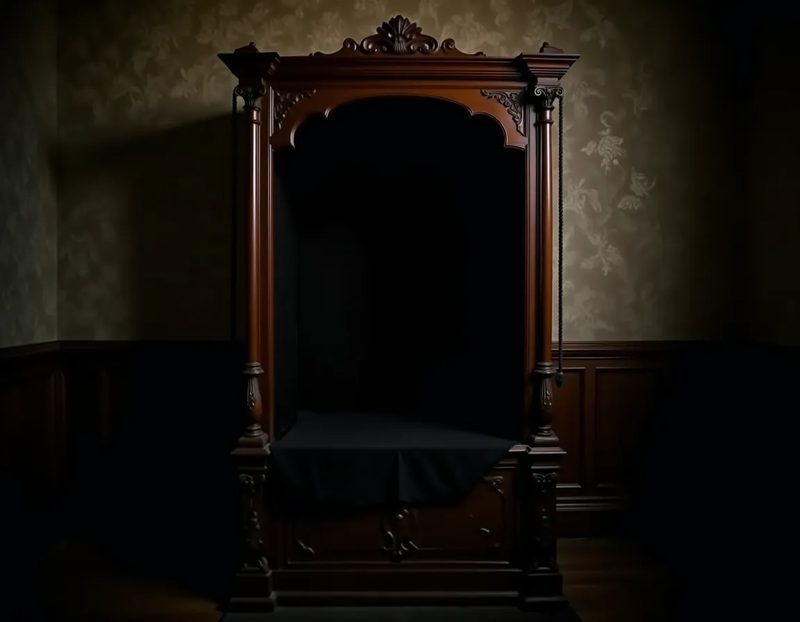
antique wooden séance cabinet with black curtain drawn, two rope loops visible at the sides, set against wallpapered Vic

After that, many people began to use the séance cabinet for séances. Setting things up was easy. The medium sat inside a small wooden box. The box had a window. The box had a curtain. The lights turned off. Many people play different types of instruments. I saw hands come out from the opening. When the lights turned on, the ropes were still wrapped around the medium. The Davenport method does not mean much for people who perform today.

The cabinet set this rule for the theater. The cabinet said, I am stuck here. You cannot blame the cabinet. But sometimes, strange things just happen. That building is still there. The building looks strong. The building was still there in 1865. Annemann said that if you use confinement, you can make conviction stronger. When people in the crowd see the performer tied up, they think the next part will be harder. The cabinet got the idea and made the idea real.

Most period cabinets used two or three wood panels. The front had a curtain. Inside, the sitting space was small. There is nothing special here. Secondary Controls: The Mechanics of the Witnessed Release

The story started when something happened outside the cabinet. The cabinet stayed silent. It helps when you remember to hold back. Secondary Controls: The release control changed how the séance went. I saw someone look at the release control. The release control had a big role in the séance.

Secondary Controls: The Mechanics of the Witnessed Release

The sitters held the medium’s hands in the dark. They used their hands to tie the wrists together. They sat close to the feet of the medium. A Victorian séance felt like people came and went. The sitter watched for signs or answers. The sitter waited. The medium tried to move with ease. I saw that I had to use the other controls. A secondary control takes place when the sitter thinks the sitter is holding the medium. The sitter holds something else.

This hand might belong to someone else. The medium can move the arm to the other side. The medium can bring the arm back again. Sometimes the arm is not real. Sometimes a device picks things up like a hand, but the device does not use the person’s real hand. Hereward Carrington talked about these things in “The Physical Phenomena of Spiritualism” in 1907. Carrington tried to show the tricks. Many performers used the book for help. He knew some good ways to trade things. When the sun goes down, I use my hands to touch what is close to me.

Some people can trick touch with ease. A medium can keep the sitter’s hands on the table. The medium can lift one hand for a short time, and the sitter might not notice it. The odd performer knows how to use the other controls. The strange performer can use the whole system. The strange performer can do things in the dark. This is not rope escape. This seems personal to me. Someone in the crowd thinks the medium holds the person by the hand. The person looks up and sees the medium on the other side of the room, away from everyone else.

The medium holds some bright things. Some things only show halfway. These things rarely happen in a stage escape act. The sitter saw the effect and agreed with it. This is why people see the impossible thing. You can help small things stand out, or you can lift someone’s spirit. This does not need much work. It takes longer to make the whole spirit feel real. You need to get ready and make a plan to do it right. Any medium can show up after you set things up.

Luminous Accessories and Partial Materialization

I notice someone has a hand raised. Sometimes I see a face behind the gauze. You might spot two glowing eyes in the dark. The props did not stand out to me. If you put zinc sulfide on muslin or on thin gauze, the fabric gives off a soft light. If you use a hidden rod to hold the fabric or put the fabric over your hand, the fabric can look like it is floating. Some people took some wire. They bent the wire. The wire looked like hands. People put glow paint on the wire hands.

People reached out their hands to other people. The others sat down. Each person took a foldable stick and held the stick. Some people took rubber gloves. Some people put some glowing stuff on the rubber gloves. They filled the rubber gloves with air. The gloves puffed up. The gloves looked like hands. I put my hands on the thin cloth by the cabinet door. Katharine Bates wrote about a séance from the 1880s.

People at the séance said they saw a spirit hand. People touched the hand. People felt how warm the hand was. The spirit took the paper and wrote some messages. The spirit hand would pick up the gifts people brought to the séance. When the séance was over, the hand was not there anymore. Two out of the three things are rubber gloves. The rubber gloves have warm water inside. You can write this part yourself. Most people who perform today have never tried glowing accessories.

A glowing hand can do more than just make people laugh. When someone makes a glowing hand with care and uses the glowing hand in the right story, the glowing hand can have a bigger impact. When there is no light and the sitters stay quiet, everything feels strange. Choose the best music for the story. The feeling stays even when the lights are on. The billet work in the séance room feels like the main test in the meeting. The message that was intercepted stands out during the billet work. Someone stopped the message at this time. Someone writes a question on a sheet of paper. Then the person seals the paper.

Billet Work and the Intercepted Message

The medium takes the sealed paper and reads the question out loud. The medium keeps the paper closed. Sometimes it feels like it burns. Many Victorian mediums used billet reading. The technology started out as something simple. After some time, the technology improved. You can hold the billet in your hand when you pick up the billet. Someone can check the billet before the lights go out. Someone can take out the billet and put in a blank billet. One person sits at the top and makes the thumbnails.

Someone helps people in the waiting room. Someone else can look behind the stage before the greeting starts. Annemann wrote Practical Mental Magic in 1944. Corinda put out “Thirteen Steps to Mentalism” after that. Corinda took the ideas and made the ideas better. The strange performer cares about the past. When you pick up a billet during a séance and say the message is from someone who has died, you are using something created for the séance. It fits, but it does not work well for a modern mentalism show. I think a modern mentalism show needs something else. The sitter wrote the name of the sitter’s dead mother.

You know this already. When you watch things happen at a séance, the feeling is different from the way you learn things during mentalism at a business event. The meaning changes based on the situation. When people have a séance, a billet reading can seem personal and a bit strange. Some Victorian mediums used to start with a prayer. Someone said the prayer. An assistant got some sealed slips and placed the slips in a basket. The assistant picked up the basket and took the basket to a nearby room. The medium asked questions. The knocks gave answers in a code.

After that, the medium went back inside. Basic. It works fine. The sitters made up their minds before the medium started to talk. People used the Ouija board before 1966. Parker Brothers began selling the Ouija board in 1966. The Ouija board by Parker Brothers came in a box. People in America began to use talking boards for spiritual reasons in the 1880s. People once used planchettes to try to speak with spirits. Most people do not think the talking board is scary.

Most people do not see the talking board as a toy. People in the Victorian era used a tool to talk to spirits. People saw the talking board in plays before Parker Brothers made the talking board. Some people take the tool to parties. Some people buy the tool because it is fun. A long time ago, people wrote by hand on pieces of wood. People used thick boards when people made the first writing boards. Most planchettes were made from wood. A small glass ball or lens sat in the middle. The glass helped the planchette move across the table easily.

The Talking Board Before Parker Brothers Got Involved

Two people place their fingers on the planchette. The thing moved. I saw it point at the letters. The system kept the messages. Most times, the ideomotor effect moves the planchette. Small muscle movements, shaped by what people think will happen and by what others in the group do, make the pointer move even if people do not want to move the pointer. This is real physiology, not magic. After some time, the performer sees the change. What matters is that when many people sit in the same room, they work together to share a message. These people did not plan for this message.

I do not think this is what I wrote. That can help the scene stand out. A hand-made talking board that someone used in a real séance feels different from a Hasbro board. The materials matter. The wood feels heavy in my hands. Someone wrote the letters by hand. The planchette has some brass parts. These things make people see it in a new way. If you want to set up a séance show, the tool you pick matters just as much as how you use the tool. Someone got the Victorian Arsenal ready for a show today.

I saw people moving things and checking that everything was set. The place felt busy and everyone looked full of life. The instruments listed above are not kept in the museum. These methods use props. If you use any of these in a magic show or a mind-reading show, the audience will notice something else. This new feeling can help people when people have already seen most things. These are some notes about integration. First, share the background. Put the Victorian arsenal on the stage for the show. After that, bring in the props.

The trumpet needs a frame. The board needs a frame around it. The cabinet needs a frame to stay sturdy. If you put them in a modern mentalism show, they look like tricks. If you add a séance scene to the story, even if it is simple, the history of séances gives it more meaning. The séance scene can help the story move forward. The room shows how people lived in the past. A tin trumpet with tape over a crack sounds different from an old trumpet that still works. People notice the quality of the material, even when people do not know the reason. The look of something can change how a room feels.

Staging the Victorian Arsenal in a Modern Performance

If something looks real, the room feels one way. If it does not look real, the room feels another way. When something changes about the object, how it looks can change how people feel in the room. Sometimes something that looks real can make the room feel different. When the object moves or changes, the feeling in the room can change too. People can use darkness as a tool. The darkness covers everything. Darkness changes many things as well. Many Victorian mediums worked in the dark. Let us put the context before the props.

The trumpet needs a frame. The board needs a frame. The cabinet needs a frame. If I use these in a modern mentalism show, these look like tricks. So I do not want to use these. When you set up a séance, even a simple séance, the history behind séances gives it meaning and helps tell the story. The meaning of the séance comes from the history of séances. The story of the séance feels richer because of the past. The time in the room is right. A tin trumpet that has tape over a crack is not the same as a good period instrument.

  • Context before props. The trumpet, the board, the cabinet: these objects need a frame. Drop them into a contemporary mentalism show and they look like gimmicks. Build a séance context, even a stripped-down one, and they carry historical weight that does the dramatic work for you.
  • Period accuracy reads in the room. A tin trumpet with tape over a crack is not the same as a properly constructed period instrument. Audiences respond to material quality even when they cannot articulate why. The apparent authenticity of the object changes the room’s receptivity to what happens with it.
  • Darkness is an instrument, not just cover. Victorian mediums worked in darkness because darkness is a psychological condition. Sitters lose spatial reference, hearing sharpens, touch becomes unreliable. This works whether your audience is sitting in 1882 or 2025.
  • One prop at a time. The temptation is to stage a full Victorian séance with everything available. Resist it. One well-executed trumpet effect in a minimal performance is more powerful than a prop-heavy spectacle. Weight comes from detail, not volume.

People can tell when something is good, even if people do not know the reason. If the object looks real, the room reacts more. If the object does not look real, the room reacts less. The way the object looks changes how the room reacts. People can use darkness as a tool. Darkness does more than just hide things. Victorian mediums held sessions in the dark. The dark can make people feel and think in different ways. When people get lost, people listen more. The sense of touch does not feel as sharp.

This will work for the audience in 1882 or in 2025. Take one prop each time. I want to set up a real Victorian séance with all the usual things. Do not let it win. A single trumpet sound in a simple show can get more notice than a show with many props. Weight comes from the detail, not from how much detail there is. The darkness made people feel something deep inside them. The darkness touched something real in every person. Sometimes the sitters do not know where the other sitters are. I hear better now. The sense of touch gets weaker. This works for people in 1882 and for people in 2025. Pick up the prop. Put the prop down. Pick up the next prop. Hold only one prop at a time. You can hold a Victorian séance and use anything you find. Try your best and keep moving forward. A loud trumpet draws more attention in a small show. When there are many props in the show, people notice the trumpet less. The detail helps it stand out more. Just because you own many things, it does not mean the things are heavier. People who understood attention, belief, and the mind set up the Victorian séance room with skill. People kept the knowledge after the spiritualist movement ended. Some people learned what they could and showed others. The knowledge stayed when the movement was done. Anyone who wants to do the work the right way can use it. If you want instruments from a certain time, if you want to set up a séance show, or if you need props with real history, you can go to the Arcane Relics shop. Everything at the place works well for people who care about doing a good job. The place does not like people who want something different.

Pre-Show as Performance: The Art of Intelligence Gathering Before the First Effect Begins

Pre-Show as Performance: Intelligence Gathering Before the First Effect Begins

The show doesn’t begin when you ask for silence. For a working mentalist, the show begins when the first guest arrives, or in some cases when the person who greets you at a venue mentions that the guest of honor has a mother who passed away recently. That piece of information correctly filed away becomes the key upon which the entire evening will hang. Pre-show isn’t preparation.

The Pre-Show Window Is Finite and Unforgiving

Pre-show is the opening act to a performance you probably won’t even realize is happening. The Pre-Show Window Is Finite and Unforgiving There is a pre-show window that opens as soon as guests begin to arrive for your performance and closes as soon as you take your stage. Experienced performers know this window is rarely open for longer than 20 minutes in close-up, 30 minutes in stage settings. Every minute that you’re socializing rather than working during this window is a minute of information you’ll never get back.

While most mentalists struggle to keep the performance concept in mind at all during this time, failing to transition seamlessly from a preparatory state to performance mode, they often fall into one of the common pitfalls of this time frame: setting up props, mentally rehearsing routines, and standing by waiting for the act to begin. In the mean time, the guests are socializing. They’re introducing each other and explaining their relationship to each other. They’re mentioning names, dates, and preferences.

The entire time they’re completely unaware that there is a working mentalist in their midst listening for important information. Working the Pre-Show Window Effectively Strategic conversation during this time isn’t small talk. In fact finding isn’t casual. It isn’t natural.

Engineering Useful Conversations

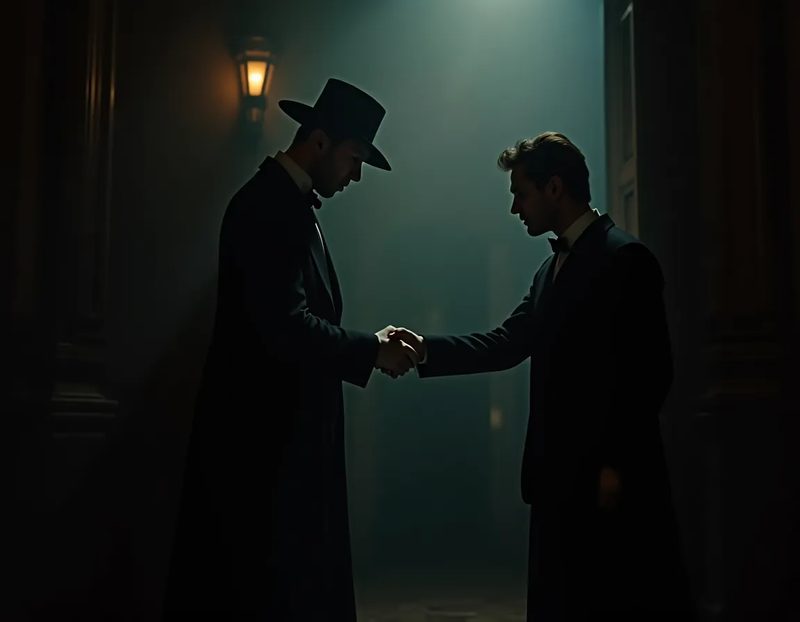
performer in dark suit shaking hands with a guest at a venue entrance, leaning slightly forward in attentive posture

It takes work and an understanding of the psychology of what’s happening and what’s necessary in order to elicit the information that you’ll need during the act. There are three principles you should keep in mind when trying to collect information during this period: Ask open-ended questions that yield proper nouns “What brings you here tonight?” doesn’t yield as much useful information as “How do you know the host?” Proper nouns give the mentalist context that they can later use in the performance and they serve to anchor specific details to time and place. The first sentence of a reply will always include the wording that you asked for, but it’s the second sentence of the reply that yields the most useful information. Ask for additional information after they’ve told you what they think you want to hear: “She mentioned her friend David” and “She mentioned a friend” are not quite the same to a working mentalist.

Ask for additional information after they’ve told you what they think you want to hear and you’ll find that they’re happy to share as much information as you’ll allow them to. Be receptive to topics that they bring up. The most useful information will always arise organically and will be related to topics that they want to discuss. Be receptive and you’ll get more than you would if you were to steer the conversation in a specific direction.

  • Ask open questions that return proper nouns. “What brings you here tonight?” nets you little. “How do you know the host?” gives you a name, a context, and a relationship to map. Proper nouns anchor specificity in a show. “She mentioned her friend David” lands differently than “she mentioned a friend.”
  • Listen for the second sentence. The first sentence is usually managed. The second sentence is where people tell you what they actually think. Give people room to keep talking after their initial answer and you will collect something useful roughly sixty percent of the time.
  • Let the topic land on you, not the other way around. The best pre-show intelligence comes from subjects the guest raises voluntarily. A comment about a long drive from the coast gives you geography. A mention of a recent health scare gives you something more. You do not steer toward these things. You create the conditions for them to surface.

Working the Room Before Anybody Takes a Seat A working mentalist has complete control of the venue before an audience member ever sits down or even takes notice of their presence. Having control of the environment before a performance is the key to seamlessly integrating it into the show itself. All of the information contained in this section is in addition to your natural working knowledge of a venue and everything you’ve learned up to this point about a performance. Some of the information contained here will be entirely new to you while other parts will be reinforced from your experience with magic and mentalism.

Reading the Room Before Anyone Sits Down

It is all important. Begin by learning the space without any people in it. Pay particular attention to the entry and exit points and the path that guests will follow as they move into the performance area. Take a look at the bar and try to get an idea of who will be standing there during the performance, and where they’ll be relative to the other audience members.

As guests begin to arrive, pay particular attention to their clusters and movement patterns. Remember that extroverted guests will tend to seek out and take up space nearest to entrances and exits. Guests who are shy or wish to avoid social interaction during the performance will hug the walls and seek to put as much distance between themselves and the rest of the audience as possible. Couples will often sit apart during the performance if they’re not speaking to one another.

These patterns should be studied and taken into consideration when crafting your act. A bizarre magic performer should also be aware of the ambient props in a space that will be available to them to set up and use during the act. Having a sealed envelope sitting on a table and a covered object on a pedestal before an audience takes notice of them is very different from doing so after the audience has taken their seats and is focused upon the performance. Having an open book face down on a chair before an audience takes notice of it is very different from doing so after the audience has taken their seats and is focused upon the performance.

Engineering Useful Conversations During this time, there is no distinction between socializing and performing. Strategic conversation is not about being friendly to an audience and working them for information during the pre-show period. It is about about using the format of social conversations to collect the information you’ll need to perform during the main portion of your act. A working mentalist will have to be able to craft conversations that feel like social gatherings to the other participants, yet yield a high degree of useful information about the guests and relationships between the guests.

Scribe: Building a Pre-Show System That Holds

As such, pre-show conversation engineering is quite different from both magic and mentalism in a traditional sense and also quite different from most people’s everyday social interactions. Scribe: Building a Pre-Show System That Holds A working mentalist can collect a tremendous amount of information from their guests. The problem isn’t collecting it. It’s organizing it so that they can access it properly when it’s needed during the performance.

A good system for pre-show intelligence is like a scribe that serves the mentalist by allowing them to quickly and easily access the information that they’ve collected, while hiding the process from the audience’s view. Mental notes aren’t reliable and they tend to break down long before the pressure of the stage performance begins to mount. A detail that seemed very important as it was collected will begin to fade by the time you’re three effects into the main portion of the act. You’ll start to notice the faces of the people in the third row staring up at you as the mental notes you’ve collected up to this point begin to fall apart under the pressure of the stage.

Scribe serves to help fill this gap between collecting the information and having it available for you to use during the main portion of the act. It’s a tool that has been designed from the ground up to serve the needs of the working mentalist. It’s something that you can naturally use during your pre-show conversations with the guests, without drawing any suspicion to yourself, yet it serves to organize all of the important details that you’ve collected in a way that’s useful to you during your performance. The practical benefits of using Scribe as a tool to organize your pre-show intelligence are easy to see.

It enables you to cruise through a room of guests, collecting whatever information you can find along the way, while at the same time using that information to create a structured performance that will allow you to create the illusions and impressions that you’re looking to create. You can use it to build a basic intelligence picture prior to the arrival of your guests, so that you have a good idea of what they’ll be like before they start to arrive. You can then use this information to help build your set list and guide your decisions regarding the main portion of your act. Collecting Intelligence and Depoying It Without Warning There’s an art to using the information you’ve collected during the pre-show period, and presenting it to the right people at the right time in such a way that it always feels right and never like magic or trickery.

The timing of when you deploy the information you’ve collected will be critical. There’s an art to presenting the information in such a way that it never feels like you’re using it. When you present correct information at the wrong time, it always comes across as luck. Present it at the right time, and in the right context, and it will always feel like more than luck.

Deploying Intelligence Without Telegraphing the Work

Again, it’s a matter of presenting it in such a way that it feels right rather than like it’s part of a trick. The timing of when you use the information you’ve collected is important but it’s not the only thing. It’s also important that you follow a few guidelines for presenting this information so that it’s always felt organically and never as part of the performance itself. The principles to keep in mind are as follows: Never lead with specific information; Build up to it; Make the audience feel the performance of the magic as you lead them to the punch line so that they have time to fully buy into it before it’s revealed.

By presenting your information in a broad way that leads up to a specific punch line you’ll create a completely different impression than if you were to just state the information outright. Use the information to ask questions; Rather than to state information; The punch line to a question will always feel different than a statement would. Not all of the information you’ve collected during the pre-show period will necessarily be used during your performance. In fact, it’s always better to have more information than you’ll be able to use, because having more than you need adds to the impression that you could have done more if you had chosen to.

The pre-show period isn’t preparation for a performance. It’s the performance itself. The performance of magic isn’t something that you do on stage in front of the audience. It’s something you do every minute of every performance.

  1. Never lead with the specific. Build toward it. Let the audience feel the approach before the arrival. A broad statement narrowing toward a precise detail creates a different psychological experience than going straight for the name.
  2. Use the information to ask a question, not make a statement. “Is the person you’re thinking of someone who recently moved?” lands with more apparent impossibility than “You’re thinking of someone who recently moved.” The question format requires the subject to confirm, which creates a visible moment of astonishment rather than a statement they simply receive.
  3. Let some of it go unused. Not every piece of pre-show intelligence needs to be spent. If you have six strong details and you use three, the audience assumes you could have gone further and chose not to. Restraint implies depth.

Pre-Show as a Performance Philosophy

If you can keep this in mind and remember that every minute is part of your performance, then you’ll be able to create the most amazing and memorable effects possible for your audience. A mentalist who creates truly amazing performances for his audiences doesn’t think of the time before the act in terms of preparation or even in terms of working for the act. It’s more than that. The time before the act is part of the act itself.

The time before the act is the performance. The entire time before an audience takes their seats for a performance is, in effect, a continuous performance of its own. The curtain never rises because the curtain never falls. The act never begins and ends because the act never ends or begins.

If you can remember this fact and learn to see everything that you’re doing as part of this performance, you’ll be able to create an experience that’s far more mysterious and compelling than anything else that you’ve ever done before. The preparation for a stage performance is never preparation for the stage performance itself. The preparation for a stage performance is always part of the stage performance. Working a room before an audience arrives is part of the performance of magic and mystery that you do for the guests before they take their seats.

Working a bar before the audience arrives is part of the performance of magic and mystery that you do for the guests before they take their seats. In fact, the preparation for a stage performance is merely a subset of this larger act of magic and mystery that working mentalists perform for an audience on a daily basis. You’re not preparing for an act when you’re working a room or the bar prior to a performance of magic. You’re already performing.

In fact, you’re already performing at its most intimate and essential level, because the performances you give the guests while preparing for the stage show is the most important aspect of any stage show, because it provides the time spent preparing for the stage performance is always the audience’s most intimate experience with the performer during the entire performance. It’s also one of the few periods during which the audience feels free to express themselves and behave in ways that they might not feel free to do when they’re sitting in the seats and fully focused upon the stage performance. If you can perform during this time in a way that adds to the overall magic and mystery of your stage performance, you’ll create an experience for your audience members that will be far more memorable and unique than anything else that you could do. Corinda touched on this idea in The Thirteen Steps To Mentalism but to fully grasp the concept it’s up to you to apply it. The pre-show period is treated far too often as if it were a sub-set of technique, a grab-bag of things to use in an emergency. If you treat pre-show intelligence as a philosophy of performance that underpins everything you do in a show rather than as an afterthought, you’ll find that you’re able to perform at an entirely different level. The pre-show period is the period of time that begins when the guests for your show start to arrive and continue on until you take your stage. This period of time has nothing in common with what most people consider to be a performance of magic. Browse the Arcane Relics shop for tools built for performers who work at this level, including Scribe and the full range of mentalism and bizarre magic resources.

The Force Unseen: Psychological Forcing Techniques for the Modern Mentalist

The Force Unseen: Psychological Forcing Techniques for the Modern Mentalist

The best kind of force is the kind that does not even feel like force. You can mix up the cards in the deck if you know what to do. But getting someone to say the number seven without any cards is a different thing. You can see it when someone asks the question. You might notice it if there is a pause. You could find it in a hint that showed up before.

Why Psychological Forces Hold Differently Than Physical Ones

Mentalists started looking into this topic after Annemann wrote Practical Mental Effects in the 1940s. Now, books about mentalism are simpler to read than before. This breakdown helps people who know some of the topic. This overview does not help beginners. Psychological forces are different from physical forces. Sometimes a card force works, but other times people do not choose the card you want.

The classic card force does not always give the result you look for. The spectator takes the wrong card. The angle is not right. The touch gives away the secret. A psychological force does not fall apart the same way every time. Things do not always go wrong all at once.

This influence reaches many people. People in cognitive science call this idea choice architecture. The way people show choices can change which choice people choose. I will not say what I think. I will not give any idea. Kahneman’s work on System 1 and System 2 thinking shows how people think when someone watches people in a study.

Anchoring and the Weight of the First Number

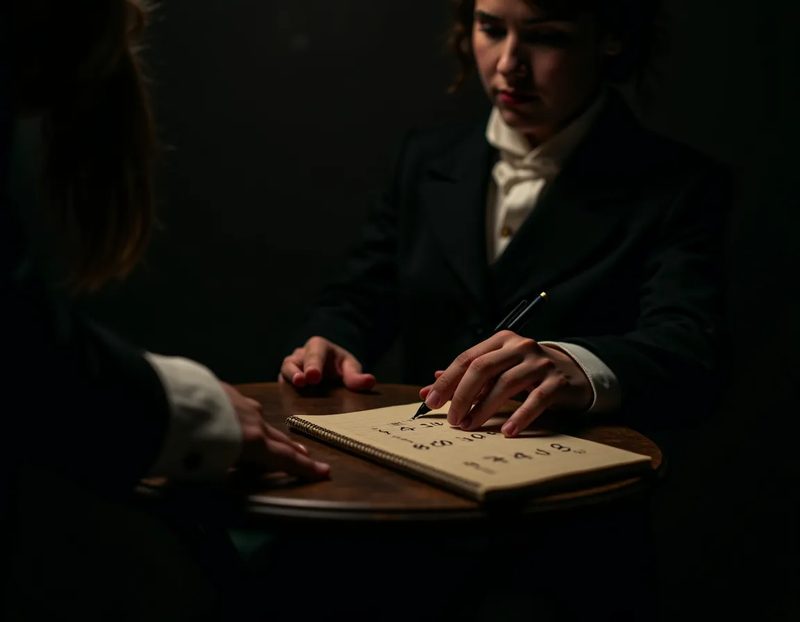
close-up of performer's hand writing a number on notepad, spectator watching from across small table

When the brain faces social pressure and does not have much time, the brain finds patterns instead of going through each step. The mind starts to work in the space between the two ways. The mentalist starts working before anyone even thinks to ask who the mentalist is. Start by setting up the environment. Build trust next. Match the pace that comes after.

Follow the earlier suggestions to decide the next step. Banachek’s Psychological Subtleties talks about many of the same ideas. Banachek explains things in a clear way. If you have not read it yet, go back and read it first. Anchoring is a common bias. Anchoring happens when the first number or fact makes people see later information in a certain way.

Many people have studied anchoring. Not many people who do mentalism talk about anchoring. Anchoring can help mentalists. The idea is simple. When people pick the first number, thing, or word, the other choices stay closer to that first choice. There is a classic trick where you ask the person to think of the number 37.

Double Anchoring

If you want someone to say a number, you can talk about 37 days, give an address in the thirties, or show something with that number. We do not use a sledgehammer when we set the anchor. Someone says something fast, and the brain remembers it. When someone asks me to pick a number, I go with the number I have in my head already. Two changes are important here. First, the anchor should not be the same as the target.

The Language of Restriction

Plant 35 sits on one side. Plant 39 stands on the other side. Plant 37 stays in the middle. People say nothing about Plant 37. The anchor should be about something people care about. The anchor can be a story.

The anchor can also be a real question. Sometimes the anchor is just something people see and notice. When people give numbers without any meaning, other people may feel like something is missing, even if no one really cares. Double Anchoring Corinda talks about anchor-based priming in 13 Steps to Mentalism. Corinda does not use that name. People have done this trick for years.

People give the numbers before and after the number they want. Then people ask for any number. People used this trick long before someone named the trick. Today, performers can use intention. Make sure you know the exact numbers you plant. Find out why people use brackets around the target.

Do not guess. Do not hope. People use strong words and clear words when people talk about Restriction Elimination. You show the options and then hide the unwanted options quickly, so most people do not notice the options are missing. The easy way to say this is, do not picture a red card. Most people think of a red card.

Priming Before the Decision Point

The rule is in a short guide. The guide says, “I want you to stay away from things that look too clear, too simple, or things a mentalist often picks.”You did not add the safe choices. You did not add the clear choices. What stays behind often builds up near your target. The rule works for things and numbers. If you ask someone to pick one envelope from three envelopes, the way you talk about the other two envelopes can make those envelopes feel more or less important to that person.

Pick the wrong ones when you talk. Take a quick look at them. Then use your body to show you have finished. The person watching will choose the hand that you did not block. Restriction framing works best when the spectator feels like the spectator has more choices and not fewer choices. When someone says, “I want your genuinely free choice, not something you think I would guess,” it feels like a rule instead of a real offer.

Listen to your own scripts to hear how they sound. Priming starts before people make any choice. The hidden forces start to work before anyone talks about a decision. Priming takes place when you see or hear something by chance. Your mind begins to link these things. When you need that idea or try to remember it later, it comes to you quickly.

Word priming is the simple form. Begin the talk using words that are similar to your main word. When I think about fire, I remember how warm fire feels. Fire reminds me of summer days. Fire gives light. Fire gives heat.

Framing the Question Itself

Fire shows that something is burning. The spectator cannot see a pattern. The spectator just knows that when someone asks for an element, fire comes up first and it feels right. Object priming works better, but people do not use object priming often. Before you decide, you set up the space or the spot where you look so the main object stands out more. No, not really.

I do not want to come across as rude. Just a little. Make it easier to spot the difference. The position is a bit closer. This person faces the viewer. The others sit straight on.

The mind does not see these small signals. These signals can make the hand move. The priming time must be exact. If you try it too soon, the link goes away. If the suggestion comes just before the decision, the spectator might see the connection and think someone is guiding the spectator. The window stays open for about one to one and a half minutes before the decision point.

You need to keep practicing this until you feel comfortable doing this on stage. Most mentalists take months to learn the force method. Many mentalists spend about twenty minutes to figure out how to ask the question. We need to change the ratio. Or we need to make the ratio more balanced. The question that asks for the choice matters.

Putting the Structure Together in Performance

Each one of these feels dull. It does not show the way. Which one do you think belongs to you?is different. When people really like something without thinking too hard, talking about it makes other people want it too. Choosing that thing feels like the right choice, not just any choice. The spectator does not take any envelope.

The spectator just looks for the envelope with the spectator’s name on it. The way you see things helps people. Questions with ideas can help with this too. Pick the one you like and let me know. This means you already decided. The spectator does not begin to choose when you ask.

  1. Environmental setup before performance: Position props so the target sits in the natural sightline. Not front and center; slightly favored.
  2. Verbal priming during rapport building: Plant the semantic field of your target through casual conversation. Two to three touches, spaced, not clustered.
  3. Anchoring 30 to 60 seconds before the decision: Introduce numbers or words that bracket the target naturally in context.
  4. Restriction framing at the decision moment: Present the ask using language that pre-excludes the non-targets without appearing to do so.
  5. Ownership language on the final ask: Use recognition or identity framing to invite the selection rather than command it.

The spectator knows that the choice began earlier. The word “settled” means coming to an end when there are only a few choices left. Banachek goes through these question structures in detail. The words used in a force question matter. Each word can bring the goal closer or make the goal harder to reach. When you put the structure together during a show, the real power comes from more than one way of doing things.

Three or four people go one after the other. Each person goes into the room alone. There are never two people in the room at the same time. This is how the setup works. First, check that the environment is ready before you start. Put the props where you can see the target easily.

Do not put it in the middle. Move it to the side a little. Pick the main topic you want to talk about before you meet someone. Use words from that topic as you talk. This helps you guide the talk the way you want. Make two or three touches.

Leave a space after each touch. Do not put the touches too close together. Put the numbers or words near the target about thirty seconds to one minute before you pick. Make sure the numbers or words match what is happening. When you ask a question, use words that tell who you are talking to. Pick words that do not leave anyone out. Use these words at the start of the question. For the last question, try to ask in a way that helps the person feel included or noticed, rather than just giving instructions. The many layers make the psychological force harder to see than the physical force. You can show this in different ways. The spectator can pick one layer. The spectator does not know how the layers got put together. There is something else. These ways work well for people who watch things closely and feel a bit of pressure from the people near them. A distant or unfriendly watcher stays away from these things. The watcher does not hold back because the watcher has a side. The watcher stays back because to feel this, the watcher would need to join in first. The force checks the spectator area and gets it ready before the event starts. People do not talk about that part in the books as much as people should talk about that part. Take a look at the structure. Try to get the timing right. Make a language library for each layer yourself. The force stands out because someone made the force that way. People build this force on purpose. No one finds this force by accident. Do you want to know more?You can visit the Arcane Relics shop if you want books, old papers, and tools for mentalism. The shop offers only items picked for real mentalism work. The literature is there. The props hold it up. The props stay there.

Annemann’s Shadow: How ‘Practical Mental Effects’ Quietly Rewired Modern Mentalism

Annemann's Shadow: How 'Practical Mental Effects' Quietly Rewired Modern Mentalism

The Book That Defined the Genre Without Saying So

Pick up a copy of Practical Mental Effects and you are holding something that has shaped every professional mentalist working today, whether they know it or not. Most know it. Some have simply forgotten to notice the debt.

Published in 1944 by Max Holden, two years after Annemann’s death, the book compiled effects from The Jinx, the influential periodical Annemann ran from 1934 to 1941. Over two hundred effects. Organized by method. Dense, specific, occasionally repetitive. Not a manifesto. Not a theory book. A working document from a working performer.

That practicality is exactly why it lasted. Annemann was not writing for posterity. He was writing for the guy who had a club date on Saturday and needed something that played. The fact that his solutions still play, eighty years later, tells you everything about the quality of his thinking.

What gets missed in casual discussion of the book is how much of its influence operates below the surface. Performers cite Annemann for specific effects. They rarely cite him for the deeper structural decisions that quietly shaped how modern mentalism is built, presented, and justified.

What The Jinx Actually Was

What The Jinx Actually Was

Before the book, there was the magazine. The Jinx ran for 151 issues. Annemann edited, wrote, and largely populated it himself, pulling in contributions from Corinda before Corinda was Corinda, from Bruce Elliott, from Stewart James. The subscriber list read like a working roster of mid-century mentalism.

What Annemann built across those issues was not just an effects library. It was a shared vocabulary. When performers talked to each other about billets, book tests, or center tears, they were increasingly talking in Annemann’s terms. He did not invent all of those methods, not even close, but he standardized the language around them. That standardization is invisible now because we absorbed it completely.

Corinda acknowledged this. Banachek’s work shows it. When you read 13 Steps to Mentalism alongside PME, you see Corinda expanding on a foundation Annemann already poured. The vocabulary, the categories, the basic taxonomy of mentalism as a performing genre, all of it runs through Annemann’s decade of publishing.

The Effects That Became Templates

The book contains over two hundred effects. Not all of them survived. Plenty are period pieces, dependent on props or cultural assumptions that no longer hold. But a specific cluster became structural templates that working mentalists still build around.

Billet work is the clearest example. Annemann’s billet handling techniques, particularly his center tear variations, remain foundational. The basic logic of the center tear, destroy the evidence while retaining the information, is Annemann’s codified approach. He did not invent it wholesale, but he articulated it clearly enough that generations learned it from him rather than from vaguer earlier sources.

His thought-of-card material was similarly influential. “The Jinx” card in wallet is still in rotation. The underlying construction, a natural, low-heat selection process followed by a controlled, seemingly impossible revelation, became a template for how mentalists structure single-object demonstrations. The pacing alone is instructive: Annemann gave the selection process more time than the revelation. He understood that the journey mattered as much as the destination.

His book test thinking, distributed across multiple issues of The Jinx and collected in PME, influenced how the entire format developed. He kept returning to the problem of getting a thought into a book and a thought out of a performer’s mind without apparatus, without assistants, without anything that looked like machinery. That constraint, self-imposed, produced cleaner thinking than performers who had no such restrictions.

His Q&A act structure deserves separate mention. The one-ahead principle was not his invention, but his applications of it, and his discussion of how to pace a Q&A act for genuine theatrical weight, shaped how the format is taught and performed today. Read his notes on timing and you are reading something that still applies to any mentalist building a center piece for a corporate room.

The Presentational Logic Nobody Credits

The Presentational Logic Nobody Credits

Effects are the easy part to trace. What is harder to see, and more important, is how Annemann’s presentational philosophy seeped into modern practice.

Annemann wrote consistently about naturalism. Not the theatrical naturalism of the stage actor, but the social naturalism of a person at a dinner table. He wanted mentalism to look like something happening, not something being performed. That preference shows up in his prop choices, his handling instructions, and his scripting notes.

He favored what he called “casual” handling. The billet that is not handled carefully because it does not need to be. The book that sits on the table rather than being ritualistically produced. The spectator who is spoken to rather than directed. These choices were deliberate, and they ran against the theatrical grain of much 1930s stage magic.

Contemporary mentalism, at its best, still operates on this logic. When Banachek talks about natural body language or psychological convincers, he is speaking a language with Annemann’s fingerprints on it. When performers talk about removing the “magic show” feel from mentalism, they are arguing for something Annemann argued for in 1937.

The specific phrase Annemann used often was “convincing.” Not “amazing.” Not “mystifying.” Convincing. He wanted the audience to believe, or at least to be unable to disbelieve. That is a different target than the standard conjuring goal of astonishment, and it produced different methods and different scripts.

The Ethics Hiding in the Margins

Annemann was not comfortable with the ethics question. Read across the full run of The Jinx and you see him returning to it without resolution, which is itself instructive.

He never settled on a clean position about whether mentalists should claim genuine psychic ability. He understood the performance value of leaving the question open. He also understood the moral problem with that choice. His own published advice shifted over the years, sometimes favoring explicit “for entertainment” framing, sometimes clearly recommending the ambiguous approach that lets audiences decide what they saw.

That unresolved tension is exactly where modern mentalism still lives. The ethics debate you hear in green rooms and convention hallways today, should you claim powers or not, how explicit does your disclaimer need to be, what do you owe an audience that genuinely believes, all of it is a continuation of an argument Annemann was having with himself in print between 1934 and 1941.

He did not resolve it. Neither has the field. But Annemann’s willingness to think about it seriously, and to publish that thinking, helped establish that the ethics question was worth taking seriously at all. In a genre that was not particularly interested in self-examination, that was not nothing.

What Modern Mentalism Borrowed and What It Missed

The methods transferred well. The presentational philosophy transferred imperfectly. The ethical seriousness transferred least of all.

Modern mentalism absorbed Annemann’s technical solutions and sometimes his naturalistic handling. It frequently missed his insistence on economy. Annemann’s effects are lean. He cut what did not need to be there. Contemporary mentalism, particularly in the post-Derren-Brown era, often adds layers of psychological framing that Annemann would have found indulgent. Not wrong, necessarily, but padded.

He also had a clarity about what mentalism was for that sometimes gets lost. It was not therapy. It was not self-help. It was not a delivery mechanism for messages about human potential. It was performance, and performance was enough. The effect had to work on a practical, theatrical level before it could work on any other level. That order of operations matters.

Performers who go back to PME with fresh eyes consistently report the same thing: the book is more modern than it looks. Strip away the period-specific prop references and the dated social contexts, and what remains is a rigorous set of arguments about what mentalism can do and how it should do it. Those arguments have not aged out.

What Annemann built, between a magazine nobody outside the trade read and a posthumous book nobody outside the trade bought, was the structural grammar of a performing genre. Mentalism had practitioners before him. It had a grammar because of him.

Most performers working today are writing sentences in that grammar without knowing who taught them the rules.

Where to Go From Here

If you have not read Practical Mental Effects cover to cover, with a performer’s eye rather than a collector’s, do that first. Read it alongside the specific issues of The Jinx if you can find them. The context matters.

Then read Corinda’s 13 Steps again, noticing where the DNA matches. Then Banachek’s Psychological Subtleties series. The lineage is clear once you are looking for it.

Annemann’s methods are practical, which is what he said on the cover. His influence is structural, which is what nobody says enough. Both are worth your time.

At Arcane Relics, we stock serious tools for serious performers, including classic mentalism texts, contemporary billet workers, and working props built around the methodologies that have held up since Annemann proved they would. If you are building a mentalism act that actually works, or refining one that mostly does, start with what has already been proven.

Browse the Arcane Relics shop for mentalism books, props, and performance tools selected for working performers.

Spirit Slates and Their Shadows: The Forgotten Spiritualist Prop That Still Haunts the Stage

Spirit Slates and Their Shadows: The Forgotten Spiritualist Prop That Still Haunts the Stage

Chalk and Darkness

Pick up a genuine Victorian spirit slate. Feel the weight of it. The blackened surface, the wooden frame, the faint ghost of chalk that no amount of cleaning fully removes. There is something in the object itself that a folded piece of paper or a digital display cannot fake. The slate carries history in its grain.

Spirit slates are one of the most misunderstood props in the serious performer’s toolkit. Most magicians dismiss them as relics, dusty frauds from the Spiritualist era. That is exactly wrong. The best bizarre magic workers today understand what the Victorian mediums understood instinctively: the prop does half the work before you open your mouth.

This is the story of where slates came from, who used them, what made them work, and why they belong on the working table of anyone performing theatrical mentalism or bizarre magic right now.

The Seance Circuit: Where Slates Came From

The Seance Circuit: Where Slates Came From

American Spiritualism erupted after the Fox sisters of Hydesville, New York claimed in 1848 that mysterious rappings in their farmhouse were communications from the dead. By the 1860s, the movement had spread across the United States and Britain with the speed of a fever. Mediums ran what amounted to a touring theatrical circuit, performing in parlors, lecture halls, and dedicated spirit rooms for paying audiences who desperately wanted contact with lost husbands, children, and parents.

Slate writing appeared on that circuit in the 1870s and became one of the defining phenomena of the movement. The premise was simple and brilliant. A question was written on a small chalkboard slate, the slate was sealed or held between two surfaces, and when it was opened, an answer had appeared in chalk. No human hand could have written it. Or so the story went.

Henry Slade was the figure most associated with early slate phenomena. He toured Europe in 1876 and convinced serious investigators, including the German physicist Johann Zollner, that the messages were genuine. Zollner spent years attempting to prove that the writing appeared from a fourth spatial dimension. Slade was eventually convicted of fraud in England, appealed on a technicality, and continued performing anyway. His career lasted decades. The conviction did not slow him down noticeably.

The Davenport Brothers worked related territory with their spirit cabinet, but slate workers occupied a specific niche. The slate was intimate. It came to you. You could hold it, inspect it, even write on it yourself. That proximity was part of the theater.

The Mechanics: What Was Actually Happening

The core methods were not subtle once exposed, but they were technically demanding in performance. The most common approach involved two slates with a pre-written message concealed on one inner surface. When the slates were pressed together and separated “for inspection,” the writing appeared to have materialized from nothing.

More sophisticated work involved hinged frames with a concealed flap that could turn. The performer might hand the slates for examination, both surfaces blank, reclaim them, build a moment of theater around the contact, then open them to reveal the writing. Timing and audience management were everything. The prop demanded real handling skill, not sleight of hand in the technical sense, but physical confidence and the ability to direct attention through presence alone.

A third approach used by more accomplished workers involved slates that could be cleanly switched. But the mechanical slate, worked without a confederate, was the professional standard. Annemann addressed slate work in Practical Mental Effects with characteristic directness: the method is crude, the effect is not. The gap between those two facts is where the performer lives.

The success of slate phenomena did not depend on the impossibility of the mechanism. It depended on the context built around it. A message appearing on a slate in a charged atmosphere hits differently than the same words on a card. The object carries the weight. The method is almost secondary.

The Mediums Who Owned the Stage

The Mediums Who Owned the Stage

Slade has been mentioned, but he was not alone. William Eglinton, the British medium, became one of the most celebrated slate workers of the 1880s. He worked under test conditions repeatedly and produced results that baffled investigators who were not looking carefully enough. Eglinton was eventually exposed by the conjurer John Nevil Maskelyne, who demonstrated identical effects from the stage at the Egyptian Hall in London.

That exposure made a specific argument. These are theatrical methods. They belong on stage as theater, not in parlors as fraud. The methods were identical. The framing was different. That argument has not lost its force in the intervening century and a half.

Eusapia Palladino, the Italian medium who dominated European investigations in the 1890s and early 1900s, did not specialize in slates but her career illustrated the same principles across different phenomena. She was caught cheating repeatedly, admitted it when pressed, and continued to draw serious investigators to her sittings. The desire to believe was stronger than the evidence of deception. Any performer working in the bizarre tradition should study her career carefully. She understood precisely what she was selling.

In America, the medium Pierre Keeler worked slate phenomena for over thirty years. His approach was theatrical in the fullest sense. He built a world around the sitting. Preparation, atmosphere, history, personal detail. The slate was not a trick. It was an event. That distinction is worth sitting with.

Why Slates Hit Different Than a Screen

Here is the practical argument for the working performer.

We live in a time of screens. Every person in your audience has watched video that shows things that cannot exist. Deep fakes, composites, AI-generated imagery. Their threshold for being impressed by a visual on a screen is essentially zero. Show someone a message on a phone and they assume a trick with the phone. The technology is too familiar to carry mystery.

A piece of blackboard slate with writing on it is different. It is old. It has texture. You can hand it to someone. They can feel the chalk dust under their fingers. There is no battery, no connectivity, no algorithm. The object predates their understanding of how it could have been faked. That unfamiliarity creates a gap, and that gap is where you work.

This is something the original mediums understood by necessity. They used the materials their audiences trusted as plain and ungimmickable. Slate, chalk, wood. The simplicity of the materials made the impossibility more convincing. A message appearing on a sealed slate in 1880 was more credible as a genuine impossibility than a ghostly voice from an unseen machine. Today, a message appearing on a slate in your hands is more credible than a message on a screen for exactly the same reason: the object precedes suspicion.

The physical weight of the prop matters too. You can feel it through an entire performance. Holding something real, something with documented history, changes how you carry yourself with it. The prop is not just a device. It is an actor in the piece.

Slates in the Bizarre Magic Tradition

Tony Andruzzi understood this. His work in the bizarre magic tradition, developed over decades and documented in the columns he wrote and the Invocation journal he edited, insisted on the importance of genuine artifacts over replicas. Objects that had lived in the world. Slates qualified on every count.

The question Andruzzi kept returning to was the difference between an effect and an experience. A trick produces an effect. A well-constructed bizarre piece produces an experience the audience carries with them. The slate, presented as a contact point with something that cannot be explained, does not need to simply deceive. It needs to open a door in the audience’s attention.

Eugene Burger took a similar position. His performances with spirit slates were not demonstrations of impossibility. They were invitations into a particular kind of focused attention. Burger drew heavily on Spiritualist history, not to endorse the fraud but to use the weight of it. He brought the period, the parlor, the grief of the original séance sitters into the frame. The effect was inseparable from the history that surrounded it.

That approach is still the right one for anyone working with slates today. You are not doing a chalk-and-flap trick. You are working with an object that spent a century in the hands of people who believed, or performed believing, that it could bridge the living and the dead. That history is in the prop. It is yours to use.

On the practical side: antique slates can still be found. Estate auctions, specialist dealers, occasional finds at general antique markets. The frames are usually intact. The mechanisms, when present, often still function after careful cleaning. A genuine Victorian slate in working condition is a performance prop, not just a display piece. Modern reproductions exist for performers who need consistent mechanical reliability, but the originals are worth the effort of hunting. The age shows in handling. The audience reads it.

What the Prop Demands From You

The slate is a demanding prop. It rewards preparation and punishes laziness.

You need a script in the old sense: a story attached to the object that explains why it is here and what it has witnessed. Not a long story. The best performers use less exposition than you expect. But the object needs a biography. A provenance, even a fictional one, gives the audience somewhere to stand while you work.

You need to know the history well enough that it lives in your handling rather than your patter. If you are self-conscious about the prop’s past, the audience will feel it. If you are genuinely at home in the Spiritualist tradition, the confidence will show in how you hold the thing before you say a word.

And you need to be honest with yourself about what kind of piece you are building. A slate used for a direct written revelation in a close-up parlor setting is a different animal from a slate used as a focal point in a longer theatrical arc. Corinda addressed this kind of structural decision in the Thirteen Steps without naming it in so many words: the prop and the structure must match, or both are undermined by the mismatch.

Spirit slates have been sitting in drawers and gathering dust in antique shops for decades, waiting for performers who understand what they are. The Spiritualists who used them were frauds. The theater they built around those frauds was genuine. The gap between those two facts has not closed. It is still working territory for any performer willing to enter it on its own terms.


Arcane Relics carries a rotating selection of antique and reproduction spirit slates, along with other Victorian-era props suited for bizarre magic and theatrical mentalism. We have partnered with Joseph Daniels to bring you something special: a true Victorian-style spirit slate bundled with his award-winning presentation, available exclusively through Arcane Relics.
Browse the current inventory at the Arcane Relics shop.

Continue reading: Beyond the Slate: Forgotten Instruments of the Victorian Séance Room

The Participant Problem: Managing Volunteers Who Resist, Overperform, or Try to Expose You

The Participant Problem: Managing Volunteers Who Resist, Overperform, or Try to Expose You

Every working mentalist has a story. The volunteer who whispered the method to the table next to them. The séance sitter who broke the circle, laughed, and asked if anyone else thought this was “just cold reading.” The woman who so desperately wanted to be the star of the evening that she gave false information, derailed two effects, and took her bow before you could close. These are not edge cases. They are Tuesday.

Difficult participants are not a sign that your material is weak. They are a feature of working with live audiences, and how you handle them separates the journeyman from the professional. What follows is a practitioner’s breakdown of the three archetypes you will encounter, with scripted language and structural tools for each. This is not theory. It is field-tested.

Archetype One: The Skeptic-Agitator

This person is not merely skeptical. Skepticism is fine, even useful. The skeptic-agitator wants the room to know they are skeptical, loudly, repeatedly, before anything has even happened. They announce it. “I don’t believe in any of this.” Said with a smile, directed at the people beside them, not at you.

The instinct is to engage the challenge head-on. Resist it.

Engaging the skeptic-agitator on their terms hands them the frame. Now you are defending yourself, and the audience is watching a debate, not a performance. You lose either way. Win the argument, and you look defensive. Lose it, and you are done for the night.

The correct move is displacement. Agree, sidestep, and redirect their energy into the work.

Scripted response: “Good. I prefer people who don’t assume anything. Makes the whole thing more interesting for everyone here. Would you mind holding this?”

You have validated them without conceding anything. You have given them a role. You have moved on. The audience reads this as confidence. The agitator, now holding your prop, is physically involved in the effect and has lost their perch as outside observer.

If they escalate mid-effect, “I think I know how this works” or similar, stop completely. Let the silence settle. Then: “Tell me after. Right now I need you to focus.” Short, calm, back to work. Do not explain. Do not justify. The audience will not be on the agitator’s side if you do not flinch.

The worst thing you can do is try to “win them over” through performance. You are not auditioning. Perform for the room. The agitator is one person. The room is twenty.

Archetype Two: The Scene-Stealer

Archetype Two: The Scene-Stealer

This one is trickier because they are usually delightful. They are funny, animated, cooperative, and they have absolutely no intention of ever giving you back the room. The scene-stealer does not mean harm. They are simply performing too, and they are good at it.

The danger here is cumulative. Each individual moment feels manageable. By the end of the effect, the volunteer has taken three bows, the audience is laughing at them rather than experiencing the piece, and your climax lands flat because the emotional temperature is wrong. Bizarre magic and mentalism require a specific atmosphere. Uncontrolled comedic volunteers destroy it.

Your first tool is casting. Before you invite anyone up, watch the room for sixty seconds. Corinda addresses this implicitly throughout the Thirteen Steps: your read of a participant before they become a participant is everything. The scene-stealer reveals themselves early. They are already performing for the table. Do not invite them.

When you are already working with one, the tool is reframing the role. Give them something specific to do that is quiet and physical. Hold something still. Watch something carefully. Keep their eyes on a focal point other than the audience. The moment a scene-stealer loses their audience, they often recalibrate and become genuinely useful participants.

Scripted redirect: “I’m going to need you completely still for this next part, and I need you watching this, not the room. What you see matters more than what they see. Ready?”

You have told them they are special. You have given them a job. You have directed their gaze inward, toward the work. The room can breathe again.

If the scene-stealer is generating genuine laughter and the night is casual, you can sometimes let it run briefly, then close it yourself with a wry line that re-centers you. “Alright. As entertaining as this is, we have work to do.” Warmth, not annoyance. You are the adult in the room. Act like it.

Archetype Three: The Exposure-Seeker

This is the one that requires the most care. The exposure-seeker is not loud. They are quiet, watchful, and deliberate. They have done some research. They may know the names Annemann and Banachek. They came specifically to catch you, and they are patient about it.

They will look under the table. They will ask to examine props before you are ready. They will angle for positions that compromise your sightlines. In a séance context, they will break holds deliberately to see what happens. In a one-on-one mentalism context, they will give deliberately false information and wait to see if you correct it or proceed.

The key insight: the exposure-seeker always reveals themselves through their questions. The questions come before anything suspicious happens. “Can I see that card?” before a card has appeared. “What’s in the envelope?” before the envelope is relevant. They are mapping the performance, not experiencing it.

Your first structural safeguard is control of the performance space. This is not about secrecy for its own sake. It is about managing the frame. In a parlor setting, you decide where people sit. You decide where props are placed. You decide the physical choreography of the evening before a single person walks in. The exposure-seeker cannot compromise what they cannot access.

When the questions come, treat them as genuine curiosity and redirect warmly.

Scripted response to early examination requests: “You’ll get a look at everything, I promise. Right now, put it out of your mind and just experience this. Skepticism can wait fifteen minutes.”

If they attempt to break a hold or circle during a séance piece: stop. Address it directly but without accusation. “When we break contact, we break the conditions. I need everyone maintaining this. Can you do that?” You are not calling them out. You are restating the rules. The room will apply social pressure to comply.

The exposure-seeker’s deepest vulnerability is this: they came in looking for a trick. If you deliver an experience instead of a trick, they do not know where to look. Strong bizarre magic operates in emotional and psychological territory that method-hunting cannot penetrate. They can catch a sleight. They cannot catch grief, or dread, or the specific feeling that something in the room has shifted. Build your sets around that.

Structural Safeguards Before Anyone Sits Down

Structural Safeguards Before Anyone Sits Down

Most participant problems are not solved in the moment. They are prevented beforehand. Here is what experienced performers build into their structure.

  • The pre-show read. Arrive early. Watch people as they enter and settle. Listen to how they talk to each other. You will identify your agitators, your scene-stealers, and your exposure-seekers before the first word of the performance. Cast accordingly.
  • Framing the role before the invitation. Before you call for a volunteer, tell the room what kind of participant you need. “I need someone who can stay very still and very focused.” This self-selects against the scene-stealer and creates a behavioral expectation for whoever comes up.
  • The assistant frame. In close-up and parlor contexts, calling someone your “assistant” rather than your “volunteer” changes the social contract. An assistant has a job. A volunteer is a spectator with a role. Assistants do not clown.
  • Anchoring with instruction. Before any critical moment, give specific instructions and get verbal confirmation. “I’m going to ask you to simply hold this and not let go. Can you do that?” They say yes. They are now committed. Deviation feels like a social failure on their part, not yours.
  • The safety valve effect. Build one moment early in the evening where a difficult participant could theoretically disrupt things, and make sure it does not matter if they do. This is your throwaway. Let them feel like they got something. Then proceed into the material that actually counts, and they are usually spent.

When Everything Goes Wrong Anyway

Sometimes you cast well, structure well, and frame well, and a participant still detonates your set. The envelope gets opened too early. The sitter breaks the circle and laughs. The word gets said aloud before you can contain it.

The first rule: do not show distress. The audience is watching your face, not the participant. If you look unrattled, they will assume you are unrattled. The performer who pauses, smiles slightly, and says “That’s alright, let’s try something else” is still in control. The performer who visibly scrambles has lost the room.

Have two or three reset effects that require no props and no setup. Pure observational mentalism, a piece of close work with borrowed items, something from Banachek’s Psychological Subtleties that you can run anywhere with anyone. These are your emergency exits. Know them cold. They buy you time and they often outperform whatever got derailed.

Close the evening on something solid. Audiences remember the last thing they felt. If you finish strong, the disruption in the middle becomes an interesting detail rather than the defining moment. A clean close reframes everything before it.

The Longer View

Difficult participants teach you things that cooperative ones cannot. Every agitator you neutralize sharpens your framing. Every scene-stealer you redirect develops your spatial control. Every exposure-seeker you out-maneuver deepens your understanding of what your material is actually doing versus what you think it is doing.

The performers who work consistently at the highest level have one thing in common: they do not fear the difficult participant. They have a plan. They have practiced the plan. And when the plan gets stress-tested in front of a room full of people, they discover which parts hold.

Build the plan. Test it early. Refine it often. The room will not give you a pass because it was a hard night.


Arcane Relics stocks performance tools, psychological props, and scripted pieces built for serious work in mentalism, bizarre magic, and intimate parlor formats. If you are developing a full evening or shoring up a specific weakness in your current set, browse the current catalog at arcanerelics.com/shop.

Curio as Credential: How the Right Prop Collection Signals Authority to Discerning Audiences

Curio as Credential: How the Right Prop Collection Signals Authority to Discerning Audiences

The Object Before You Say a Word

Your audience reads the table before they read you. They clock the props, the arrangement, the patina on that box, the condition of that envelope. All of this happens before your first line. It is visual argument, and it runs ahead of your script.

This is not a minor point. In bizarre magic and mentalism, belief is the mechanism. You are not selling a trick; you are selling a world in which the trick is plausible. That world needs furniture. The furniture needs to be right.

Modern manufactured props almost always fail this test, not because they are badly made, but because they are too perfectly made. They look like props. The audience does not know they know this. But they know. The nervous system is a better critic than the conscious mind.

What follows is a breakdown of specific object categories, how each one functions rhetorically in performance, and what distinguishes the objects that work from the ones that do not.

Why Age Is Not Merely Aesthetic

Why Age Is Not Merely Aesthetic

Age in an object carries information that cannot be faked cheaply. Patina on brass, foxing on paper, the particular softness of old leather: these are records of time that the nervous system processes directly. They bypass critical thinking. The brain registers “old” and draws inferences. This object existed before this performance. It has a life independent of tonight.

That independence is what you need. When a prop has clearly been manufactured for performance, it collapses inward. It announces its own fiction. When a prop has genuine age, or is presented within a coherent framework of genuine provenance, it expands outward. It implies a world the performer did not invent.

Annemann understood this intuitively, even working in an era when bizarre magic was not yet named as a genre. The objects in his work were functional, yes. But they carried weight. That weight came from selection, not manufacture.

The serious performer knows: the best props are not made. They are found. The distinction shapes everything that follows, from how you source material to how you handle it in front of people who have seen too many magic shows and will not forgive a cheap signal.

Why Every Arcane Relics Prop Starts Perfect, Then Gets Destroyed on Purpose

Every object we make begins its life in ideal condition. Clean joins. Crisp edges. Surfaces exactly as they should be straight off the workbench. We call this the “zero state”: the item as it would look the moment it was finished, brand new, before the world got its hands on it.

Then we start asking questions.

The questions are what separate a prop from a relic. When was this made? A rural cunning-man’s tool from the 1740s ages differently than a Victorian parlour curiosity. The wood type matters. The finish matters. Who owned it, and did they treasure it or throw it in a box? A loved object gets worn in specific places, where hands gripped, where it rested on a table. A neglected one gets different damage entirely.

Where was it found? That question alone changes everything. A piece pulled from a dry attic trunk has a particular kind of dust-sealed stillness to it. One recovered from a damp cellar carries a different story in every crack and bloom of discoloration. We match the aging to the origin, not the other way around.

The process is layered. First the physical surface: texture, wear patterns, patina. We work by hand, not by formula, because no two objects age identically. Then we address smell. Old paper, old leather, old wood. Each has a specific character, and a performer handing a folded document to an audience member should not be handing them something that smells like a craft supply store.

Feel is the last layer and the hardest to fake. The weight of something that has been handled for decades, the way paper softens over time, the way metal loses its sharpness. A spectator registers all of this before they consciously register anything. Get the feel wrong and you lose the moment before it starts.

We do this because your audience is closer than you think. They pick things up. They turn them over. Some of them know exactly what old things feel like. The aging we build into every Arcane Relics piece is not decoration. It is the performance.

Memento Mori and the Rhetoric of Mortality

Memento Mori and the Rhetoric of Mortality

No category of curio speaks faster than memento mori. A human skull on the table is not decoration. It is a statement about what kind of performer you are and what kind of territory you work in.

The skull says: I am comfortable with death. I have looked at it long enough that it sits next to my working materials without disturbing me. If that is my relationship with mortality, what else might I know?

This is the rhetoric of the object. It does not require explanation. In fact, explanation ruins it. The performer who points to the skull and says “I use this because…” has already lost the argument. The skull should sit there and do its work in silence.

Victorian mourning objects operate differently but in the same direction. Hair art, memorial brooches, jet jewelry, coffin plates: these objects carried grief in their original context. That context does not fully transfer, but a residue of it does. An audience today looking at a mourning brooch in a performer’s collection feels the weight of Victorian death culture, even without being able to articulate why. The object carries its history forward.

Memento mori work best when they are genuine, or least appear to be, at minimum when they fit within a collection that has clearly been assembled with knowledge. A genuine antique skull, a real period mourning piece, a verified Victorian death photograph: these carry the argument further than reproductions, because their details are specific and specific details do not lie.

The mass-produced skull from a Halloween supply chain communicates something. Just not what you want.

Ritual Objects: Implied History as Structure

Ritual objects present a different challenge. Unlike memento mori, which carry legible cultural codes on their own, ritual objects require context. A carved wooden figure means nothing without a framework. Within the right framework, it means everything.

This is where the performer’s knowledge becomes inseparable from the prop’s function. If you know what a poppet is, where it comes from, what traditions produced it and under what circumstances, that knowledge shapes how you handle it. Handling communicates knowledge. Audiences read hands the way they read faces. The performer who picks up a ritual knife incorrectly is announcing ignorance to anyone who knows better. And in the audiences that matter to the bizarre worker, there are always one or two people who know better.

For the bizarre worker specifically, the ritual object is not optional texture. It is structural. The frame of the performance, the implied world in which the effects are possible, depends on the objects being right.

Consider the specifics. A worn set of bone dice reads differently than a pristine set. A grimoire with marginalia, water staining, and a broken spine reads as used. A ritual knife with a patinated blade and a wrapped handle reads as handled. These details are not about deception; they are about coherence. The object should look like it belongs to the world you are describing, because the world you are describing should feel continuous with history rather than invented for Tuesday night.

Authenticity, where it exists, is preferable. A genuine 19th-century apothecary bottle, a real Victorian spirit cabinet photograph, an actual antique planchette: these carry the argument further than reproductions. But the key variable is not authenticity per se. It is specificity. An object with genuine details, specific markings, unusual features, a chip in the right place, will always outperform a generic reproduction. The specific is always more convincing than the general.

Antique Correspondence and the Written Artifact

Written artifacts are underused. This is a mistake that costs performers believability they did not know they were spending.

An antique letter in a performer’s working material does three things at once. It grounds the narrative in historical reality. It introduces a specific voice, the letter’s author, without requiring the performer to speak for that voice directly. And it creates a physical object that can be handed across, examined, held.

Passing matters. The moment an audience member holds the letter, the letter is real to them. They feel the age of the paper. They see the ink variation, the pressure of the nib, the idiosyncrasies of a handwriting style that is no longer alive. The nervous system does not distinguish between “this is old” and “this is relevant to what is happening right now.” Both impressions land simultaneously, and the overlap is the effect.

Antique newspapers function similarly. A specific date, a specific headline, a specific location: these details collapse distance. The audience stops experiencing the performance as performance and starts experiencing it as event. That is the goal.

For the performer building a working library of written artifacts: focus on legibility, specificity, and condition. A letter that cannot be read quickly is a prop that requires too much management. A letter with a clear narrative, even a mundane one, gives you material. The best finds are letters with unexplained references, odd closings, allusions to people and events that remain unresolved. That ambiguity is not a flaw. It is the mechanism.

Building the Collection Deliberately

There is no shortcut to a good collection. There is a method.

Start with function. Ask of every object: what does this do in performance? Not aesthetically, not symbolically in the abstract, but specifically. In which moment does this object work? What does it allow the performer to say without speaking? Objects that cannot answer this question belong in a private cabinet, not on a working table. The working table is not a museum; it is an argument, and every piece in the argument should be load-bearing.

Then move to coherence. A prop table that mixes periods, traditions, and aesthetics without a governing logic reads as a flea market, not a collection. The audience will not articulate this criticism, but they will feel the lack of authority. The collection should tell a single story about the performer’s obsession, even if that story is never spoken aloud. The story is told by proximity, arrangement, and the evident intelligence of the selections.

Estate sales, antique markets, and specialist dealers in occult and curio material are the right sources. Online auctions can work, but condition is harder to judge at distance. Photographs rarely capture patina accurately. The hand knows things the eye at screen distance does not. This is where Arcane Relics comes in we have done all this for you so that you can focus on the presentation

Build slowly. A small collection of objects that genuinely work is worth more than a crowded table that signals effort without authority. The performer with three right objects in the right arrangement will outperform the performer with thirty wrong ones, every time, before every audience.

Know what you have. If you pick up a Victorian mourning brooch at an estate sale, learn what it is. Read about mourning culture. Know the conventions: the meaning of jet versus French jet, the period conventions of hair art, the language of the imagery on coffin plates. That knowledge surfaces in how you handle the object, and handling is everything.

The credential is not the object. The credential is what the object reveals about the person who chose it.

Browse performance-ready curios, ritual objects, and bizarre magic props assembled for working performers at Arcane Relics.

“`

The Architecture of Dread: Building Atmospheric Tension Before a Single Word Is Spoken

The Architecture of Dread: Building Atmospheric Tension Before a Single Word Is Spoken

Why the Room Does Half the Work

Most performers walk into a venue and start thinking about their opening line. The serious ones arrive two hours early and start thinking about the air.

Atmospheric work is not decoration. It is not mood-setting in the theatrical sense, where lighting and set dressing support a story already written. In bizarre magic and mentalism, the atmosphere is the first act. By the time you speak your opening sentence, the audience should already be unsettled. They should not be able to explain why.

This is a learnable skill, repeatable, and entirely separate from your scripted material. What follows is a working framework for building genuine psychological tension before a single word of performance has been delivered.

Light as an Instrument, Not a Fixture

Light as an Instrument, Not a Fixture

Stage lighting is designed to make performers visible. Séance lighting is designed to make everything else uncertain.

The distinction matters. If your venue has a dimmer board, resist the temptation to simply lower the house lights to “atmospheric.” That produces darkness, not dread. Dread comes from selectivity: what is lit, what is shadowed, and where the eye keeps returning without finding resolution.

Practical light sources do this better than theatrical instruments in most intimate settings. A single oil lamp on a side table. A pair of candles at the far end of the room, positioned just beyond comfortable focus. One directional source that illuminates a prop without fully explaining it. The audience brain fills gaps. You want it busy filling gaps before you have said anything.

Color temperature matters more than most performers account for. Warm amber sources, around 2000-2200K, consistent with candlelight, read as old. They pull the room out of the present tense. Cool sources feel clinical; they work against you in a séance context unless you are deliberately building a paranormal investigation aesthetic. Know which world you are constructing before you choose your sources.

One practical note: never let all sources sit at eye level or below. A small upward-facing light placed behind an object casts its shadow onto the ceiling and walls. Shadows that move upward register as wrong. Use that.

Ambient Sound and the Grammar of Silence

Sound design for bizarre magic divides into two categories: what you play, and what you do not.

On the ambient side, the common mistake is choosing tracks that read as obviously “spooky.” Drone music, minor-key string clusters, anything that signals horror film. Genre signals safety. Safety is the opposite of what you want.

The more effective approach uses sound that is almost right. A field recording with one element that does not belong. A piece of early 20th-century phonograph music played slightly below normal speed. The sound of a building at night, with one creak that does not repeat on a predictable interval. The brain cannot habituate to irregular stimuli. It stays alert.

Volume is critical. The level should sit just below conversational speech. Guests will unconsciously lower their own voices to match. Quieter voices produce quieter bodies. Quieter bodies are more receptive, more focused, and significantly easier to direct.

On silence: learn to use it before you enter the room. If you have any control over the pre-show environment, build in a period of complete quiet before your arrival. Two minutes of ambient sound, then it stops. Then you enter. The contrast between ambient noise and silence reads as the approach of something. You become the thing that arrives after the sound stops.

The Grammar of Objects: Prop Placement Before the Show

The Grammar of Objects: Prop Placement Before the Show

Every object visible in your performance space before the show starts is making an argument. The argument is: something is going to happen here.

Prop placement is not prop display. Display arranges things to look good. Placement arranges things to create questions. There is a significant difference.

Consider the single, face-down playing card on an otherwise clear table. No deck in sight. No explanation. It was there when guests arrived. The card may mean nothing in the performance, and it does not matter. Its job was to put the question in the room.

Objects work best when placed at the edges of comfortable attention. Not centerpiece placement, not hidden; somewhere between. A pocket watch beside a chair nobody sits in. A closed book spine-out on a shelf, with a slip of paper protruding from its pages. A single glove. These items function as visual subordinate clauses. They suggest that a sentence is coming.

Avoid clutter. Three or four deliberate objects accomplish more than a full table of props. The brain treats abundance as decoration. Scarcity creates attention.

Asymmetry is your ally. Symmetrical arrangements read as controlled and designed, which is comforting. Slight asymmetry, the object that is almost but not quite aligned with its neighbors, reads as something interrupted. Something arranged by someone who was then called away.

The Pre-Show Encounter: Misdirection Before You Begin

If you have access to your audience before the formal performance begins, you have the most powerful pre-show tool available: live contact.

This does not mean performing. It does not mean doing effects in the lobby. It means controlled encounter design that plants material and primes psychology without being identifiable as performance.

The simplest version: you are present in the space as guests arrive, apparently occupied with something else. Examining an object, making a note, consulting a document. You do not immediately acknowledge the room. When you do make contact, it is brief. You learn one thing about one person, a name, a detail they volunteer, and you move on. That detail may or may not reappear in the performance. It does not matter either way. What matters is that every person in the room now holds a small, private uncertainty about what you know and when you learned it.

For seated séance work: the waiting period before guests are invited into the performance space is not dead time. If you can pipe your ambient sound into the waiting area at lower volume, do it. If your materials reference an absent third party, a medium, a deceased subject, a previous participant, refer to that person casually in pre-show conversation. “She left a note about this evening.” Do not explain it. Move on.

Annemann understood the value of the pre-show period and addressed it directly in Practical Mental Effects. Banachek’s Psychosomatic Mentalism contains sharp observations on managing the room before formal performance begins. The literature on this specific area is not extensive, but it exists. Read it carefully.

Pacing, Arrival, and the Productive Use of Waiting

The moment you enter the performance space is the first moment of the show. Most performers waste it by entering normally.

“Normally” means: the performer walks in, perhaps says hello, moves to their position, and begins. The audience has been given no reason to shift attention modes. They are still in receiving-information mode. That is not where you want them.

The alternative is to treat your entrance as a cue that something has changed. The change can be very small. You enter and do not immediately acknowledge the room. You stand at a position for a count of three before turning. You sit without speaking and adjust one object on the table before you look up. These behaviors are not theatrical in the dramatic sense. They are simply not normal. “Not normal” is the perceptual key you are looking for.

Pacing throughout the pre-show should be slower than feels comfortable. Silence should last longer than feels comfortable. The audience’s discomfort with silence is yours to use. When nobody speaks and nothing happens, attention increases. Expectation builds. When you break that silence, you arrive into a room that is listening very hard.

One technique worth considering: set a practical sound, a clock, a distant phone, a record player winding down, to trigger at a specific moment just before you speak. The transition from one sound state to another functions as a non-verbal announcement. It tells the room that something is about to begin without you having to say so. Your opening line drops into a space already prepared to receive it.

All of this is work that happens before your first effect. None of it requires new apparatus. It requires planning, early arrival, and a willingness to treat the room itself as part of your method.

The audience will not know why they felt it. They rarely do. That is the point.

Build the Room. Then Build the Show.

If you are working seriously in bizarre magic, the architecture of the experience is as important as the method behind any individual effect. A strong piece performed in a neutral room will land. The same piece performed in a room that has spent forty-five minutes building pressure will be remembered differently. It will feel like something actually happened.

That difference is not accidental. It is built.

At Arcane Relics, we stock props, atmospheric tools, and performance materials for practitioners who work at this level. Candle systems, antique staging pieces, and resources designed specifically for intimate and séance-style environments.

Browse the Arcane Relics Shop

“`

Cold Reading Is Dead — Long Live Warm Reading: A Mentalist’s Field Guide to Genuine Connection

Cold Reading Is Dead — Long Live Warm Reading: A Mentalist's Field Guide to Genuine Connection

“`html

The Problem Nobody Wants to Admit

Cold reading has a reputation problem. Not among magicians. Among everyone else.

The mechanics are on YouTube. James Randi spent decades documenting them. Pop psychology articles have turned Barnum statements into cocktail party trivia. The well-read layperson sitting down for a reading in 2026 has a reasonable chance of recognizing what a rainbow roping statement looks like. They might even catch you mid-delivery.

That’s not an accusation against cold reading as a body of knowledge. Corinda’s Thirteen Steps is still essential reading. Banachek’s work on psychological subtleties remains some of the sharpest thinking in the field. The problem isn’t the techniques. It’s using them as a primary performance framework when the audience has shifted under your feet.

Warm reading is different. It isn’t a trick. It isn’t a system you work from the outside in. It’s a set of skills, borrowed largely from behavioral psychology and clinical interview practice, that let you build a genuine picture of a person in real time. The result isn’t that your subject thinks you’re psychic. The result is that your subject feels genuinely understood. That’s a harder thing to achieve, and a much harder thing to dismiss.

What Cold Reading Actually Does (and Doesn’t Do)

What Cold Reading Actually Does (and Doesn't Do)

To be precise: cold reading works on probability. You make statements that apply broadly, delivered with enough specificity and conviction that subjects interpret them as personal. You invite them to do the interpretive work. When they confirm something, you build. When they don’t, you redirect without losing ground.

This is clever. Done well, it can be striking. The problem is that its success depends on the subject not knowing how it works, and on the performer maintaining control of the framing at all times. The moment a subject becomes skeptical, or starts testing rather than accepting, the whole structure gets fragile.

Warm reading doesn’t share that vulnerability. It doesn’t ask the subject to accept anything. It listens to what they actually say, notices what they actually do, and reflects it back with precision. The subject can be as skeptical as they like. You’re not making guesses. You’re observing.

That distinction is worth sitting with. Cold reading is a performance of insight. Warm reading is an exercise in it.

The Disclosure Loop

The core mechanic of warm reading is what behavioral researchers call the disclosure loop. The principle is straightforward: people reveal information about themselves continuously, most of it outside their conscious awareness. Your job is to create the conditions for disclosure, recognize what’s being offered, and use it precisely.

Creating conditions for disclosure means asking open questions. Not leading questions. Not questions that contain their own answers. Open questions that give the subject room to go wherever they’re inclined to go. “Tell me about something you’ve been carrying lately” is better than “I sense you’ve been under a lot of stress.” The first invites. The second performs.

What comes back is raw material. A subject might mention a family member. They might use a particular word twice. They might pause before answering, or answer quickly and then walk it back. All of that is data.

Recognition is where the skill lives. Most people hear words. A good warm reader hears the architecture of the response: where the subject went, where they didn’t, what they said with their body while saying something else with their mouth.

Reflection is the final step, and the most delicate. You take what you’ve gathered and give it back with precision and care. Not as a guess. As an observation. “You mentioned your father, but you shifted when you said his name.” That’s not a cold reading statement. That’s attention. Subjects feel the difference.

Behavioral Anchors and What to Do with Them

Behavioral Anchors and What to Do with Them

An anchor, in this context, is any specific detail a subject offers that you can tie your performance to. It could be a name, a relationship, a repeated choice of words, a physical gesture. Anchors are what separate a reading that feels personal from one that feels generic.

The mechanics of anchoring are not complicated. When a subject gives you something specific, you hold it. You don’t use it immediately. You let the conversation develop, then return to it at a moment of your choosing. “Earlier you said your mother was complicated. I want to come back to that.” The subject registers that you listened. That you remembered. That this reading is about them specifically, not about people in general.

This is also where behavioral observation earns its keep. Micro-expressions, posture shifts, changes in breathing rate, the way someone’s eyes move when accessing memory versus constructing an answer: all of it feeds the anchor bank. A good warm reader gathers more than they use. The selection is as important as the collection.

What you don’t do is over-explain. You use the anchor to illuminate something real, then let it sit. The subject will do the rest. The human mind is built to find meaning. Give it something genuine to work with and it will work.

The Difference Between Being Clever and Being Present

Here’s what most technical treatments of cold reading miss. The most technically skilled cold reader in the room is not necessarily the most effective one. Effectiveness in a reading context, especially one-on-one or in intimate group settings, depends heavily on genuine presence.

Presence is not a soft concept. It’s the quality of your attention. When a subject looks at you and talks, are you thinking about your next move, or are you actually listening? The subject can tell. Not consciously, usually, but they can feel the difference between being used and being heard.

This is where warm reading has a structural advantage. Because the method depends on actual listening, it trains presence as a byproduct. You can’t anchor what you didn’t hear. You can’t reflect what you weren’t attending to. The discipline of warm reading makes you a better listener, and better listeners are more effective performers. Full stop.

Annemann wrote about the performer’s need to genuinely care about the subject, not as a moral instruction but as a practical one. A performer who cares gets more information, builds faster rapport, and delivers readings that stick. That observation holds. Warm reading builds that quality into the method itself.

Building the Practice

This isn’t a skill you develop by reading about it. It’s a skill you develop by practicing it, systematically, in non-performance contexts first.

Start with observation. Spend time in places where you can watch people interact without participating. Coffee shops, waiting rooms, airports. Watch posture changes. Watch how people hold or break eye contact. Watch what happens to someone’s face when they’re asked a question they weren’t expecting. Build your vocabulary for what you’re seeing.

Move to conversation. Practice open questioning with people you know well enough to check your readings against afterward. Did you notice something real, or did you interpret noise as signal? Calibration takes repetition.

Add the performance layer last. Once you can observe accurately and question well, structure comes easier. You’ll know how to pace a reading, where to press and where to give room, when to surface an anchor and when to hold it.

Keep a log. Not of routines. Of observations. What did you notice tonight that you hadn’t noticed before? What did you use, and what did you leave on the table? The practitioners who develop fastest are the ones who treat every reading as data.

The Reading List and What to Do Next

If you’re serious about this, the reading list extends well past magic. Richard Bandler and John Grinder’s work on representational systems is dated in places but still useful for pattern recognition. Paul Ekman’s research on micro-expressions is the standard reference for behavioral baseline work. In the magic literature, Derren Brown’s Tricks of the Mind is worth reading not for the tricks but for its treatment of suggestion and misdirected attention. Banachek’s Psychological Subtleties series remains the most rigorous published thinking specifically for our context.

Props and tools matter more than some performers admit. A well-constructed reading deck, a thoughtfully designed stimulus object, or a structured interview framework can open a subject significantly faster than questions alone. The structure gives both parties something to focus on while the actual exchange happens underneath. The tool doesn’t do the work. It creates the conditions for the work.

What doesn’t work is treating warm reading as a softer, more ethical version of cold reading. It isn’t a substitute. It’s a different discipline with different demands, and it asks more of the performer. The return, for those willing to put in the time, is a reading practice that holds up under skepticism, generates genuine responses, and leaves subjects with something they didn’t walk in with.

That’s a harder standard than fooling someone. It’s also a more interesting one.

Arcane Relics stocks tools built for working performers: reading decks, psychological props, and materials for serious mentalism practice. No beginner kits. No shortcuts. Browse the shop at arcanerelics.com.

“`