
Chalk and Darkness
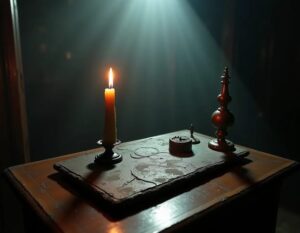
Pick up a genuine Victorian spirit slate. Feel the weight of it. The blackened surface, the wooden frame, the faint ghost of chalk that no amount of cleaning fully removes. There is something in the object itself that a folded piece of paper or a digital display cannot fake. The slate carries history in its grain.
Spirit slates are one of the most misunderstood props in the serious performer’s toolkit. Most magicians dismiss them as relics, dusty frauds from the Spiritualist era. That is exactly wrong. The best bizarre magic workers today understand what the Victorian mediums understood instinctively: the prop does half the work before you open your mouth.
This is the story of where slates came from, who used them, what made them work, and why they belong on the working table of anyone performing theatrical mentalism or bizarre magic right now.
The Seance Circuit: Where Slates Came From
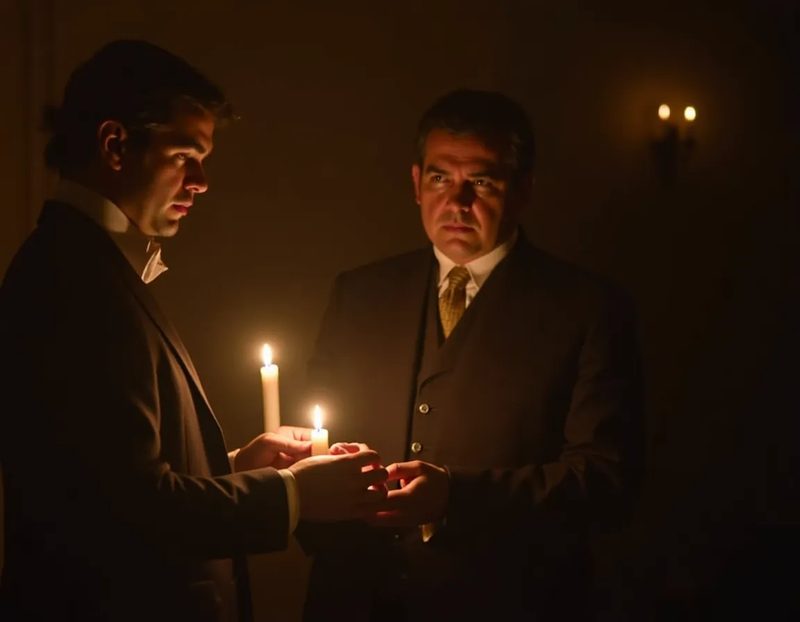
American Spiritualism erupted after the Fox sisters of Hydesville, New York claimed in 1848 that mysterious rappings in their farmhouse were communications from the dead. By the 1860s, the movement had spread across the United States and Britain with the speed of a fever. Mediums ran what amounted to a touring theatrical circuit, performing in parlors, lecture halls, and dedicated spirit rooms for paying audiences who desperately wanted contact with lost husbands, children, and parents.
Slate writing appeared on that circuit in the 1870s and became one of the defining phenomena of the movement. The premise was simple and brilliant. A question was written on a small chalkboard slate, the slate was sealed or held between two surfaces, and when it was opened, an answer had appeared in chalk. No human hand could have written it. Or so the story went.
Henry Slade was the figure most associated with early slate phenomena. He toured Europe in 1876 and convinced serious investigators, including the German physicist Johann Zollner, that the messages were genuine. Zollner spent years attempting to prove that the writing appeared from a fourth spatial dimension. Slade was eventually convicted of fraud in England, appealed on a technicality, and continued performing anyway. His career lasted decades. The conviction did not slow him down noticeably.
The Davenport Brothers worked related territory with their spirit cabinet, but slate workers occupied a specific niche. The slate was intimate. It came to you. You could hold it, inspect it, even write on it yourself. That proximity was part of the theater.
The Mechanics: What Was Actually Happening
The core methods were not subtle once exposed, but they were technically demanding in performance. The most common approach involved two slates with a pre-written message concealed on one inner surface. When the slates were pressed together and separated “for inspection,” the writing appeared to have materialized from nothing.
More sophisticated work involved hinged frames with a concealed flap that could turn. The performer might hand the slates for examination, both surfaces blank, reclaim them, build a moment of theater around the contact, then open them to reveal the writing. Timing and audience management were everything. The prop demanded real handling skill, not sleight of hand in the technical sense, but physical confidence and the ability to direct attention through presence alone.
A third approach used by more accomplished workers involved slates that could be cleanly switched. But the mechanical slate, worked without a confederate, was the professional standard. Annemann addressed slate work in Practical Mental Effects with characteristic directness: the method is crude, the effect is not. The gap between those two facts is where the performer lives.
The success of slate phenomena did not depend on the impossibility of the mechanism. It depended on the context built around it. A message appearing on a slate in a charged atmosphere hits differently than the same words on a card. The object carries the weight. The method is almost secondary.
The Mediums Who Owned the Stage

Slade has been mentioned, but he was not alone. William Eglinton, the British medium, became one of the most celebrated slate workers of the 1880s. He worked under test conditions repeatedly and produced results that baffled investigators who were not looking carefully enough. Eglinton was eventually exposed by the conjurer John Nevil Maskelyne, who demonstrated identical effects from the stage at the Egyptian Hall in London.
That exposure made a specific argument. These are theatrical methods. They belong on stage as theater, not in parlors as fraud. The methods were identical. The framing was different. That argument has not lost its force in the intervening century and a half.
Eusapia Palladino, the Italian medium who dominated European investigations in the 1890s and early 1900s, did not specialize in slates but her career illustrated the same principles across different phenomena. She was caught cheating repeatedly, admitted it when pressed, and continued to draw serious investigators to her sittings. The desire to believe was stronger than the evidence of deception. Any performer working in the bizarre tradition should study her career carefully. She understood precisely what she was selling.
In America, the medium Pierre Keeler worked slate phenomena for over thirty years. His approach was theatrical in the fullest sense. He built a world around the sitting. Preparation, atmosphere, history, personal detail. The slate was not a trick. It was an event. That distinction is worth sitting with.
Why Slates Hit Different Than a Screen
Here is the practical argument for the working performer.
We live in a time of screens. Every person in your audience has watched video that shows things that cannot exist. Deep fakes, composites, AI-generated imagery. Their threshold for being impressed by a visual on a screen is essentially zero. Show someone a message on a phone and they assume a trick with the phone. The technology is too familiar to carry mystery.
A piece of blackboard slate with writing on it is different. It is old. It has texture. You can hand it to someone. They can feel the chalk dust under their fingers. There is no battery, no connectivity, no algorithm. The object predates their understanding of how it could have been faked. That unfamiliarity creates a gap, and that gap is where you work.
This is something the original mediums understood by necessity. They used the materials their audiences trusted as plain and ungimmickable. Slate, chalk, wood. The simplicity of the materials made the impossibility more convincing. A message appearing on a sealed slate in 1880 was more credible as a genuine impossibility than a ghostly voice from an unseen machine. Today, a message appearing on a slate in your hands is more credible than a message on a screen for exactly the same reason: the object precedes suspicion.
The physical weight of the prop matters too. You can feel it through an entire performance. Holding something real, something with documented history, changes how you carry yourself with it. The prop is not just a device. It is an actor in the piece.
Slates in the Bizarre Magic Tradition
Tony Andruzzi understood this. His work in the bizarre magic tradition, developed over decades and documented in the columns he wrote and the Invocation journal he edited, insisted on the importance of genuine artifacts over replicas. Objects that had lived in the world. Slates qualified on every count.
The question Andruzzi kept returning to was the difference between an effect and an experience. A trick produces an effect. A well-constructed bizarre piece produces an experience the audience carries with them. The slate, presented as a contact point with something that cannot be explained, does not need to simply deceive. It needs to open a door in the audience’s attention.
Eugene Burger took a similar position. His performances with spirit slates were not demonstrations of impossibility. They were invitations into a particular kind of focused attention. Burger drew heavily on Spiritualist history, not to endorse the fraud but to use the weight of it. He brought the period, the parlor, the grief of the original séance sitters into the frame. The effect was inseparable from the history that surrounded it.
That approach is still the right one for anyone working with slates today. You are not doing a chalk-and-flap trick. You are working with an object that spent a century in the hands of people who believed, or performed believing, that it could bridge the living and the dead. That history is in the prop. It is yours to use.
On the practical side: antique slates can still be found. Estate auctions, specialist dealers, occasional finds at general antique markets. The frames are usually intact. The mechanisms, when present, often still function after careful cleaning. A genuine Victorian slate in working condition is a performance prop, not just a display piece. Modern reproductions exist for performers who need consistent mechanical reliability, but the originals are worth the effort of hunting. The age shows in handling. The audience reads it.
What the Prop Demands From You
The slate is a demanding prop. It rewards preparation and punishes laziness.
You need a script in the old sense: a story attached to the object that explains why it is here and what it has witnessed. Not a long story. The best performers use less exposition than you expect. But the object needs a biography. A provenance, even a fictional one, gives the audience somewhere to stand while you work.
You need to know the history well enough that it lives in your handling rather than your patter. If you are self-conscious about the prop’s past, the audience will feel it. If you are genuinely at home in the Spiritualist tradition, the confidence will show in how you hold the thing before you say a word.
And you need to be honest with yourself about what kind of piece you are building. A slate used for a direct written revelation in a close-up parlor setting is a different animal from a slate used as a focal point in a longer theatrical arc. Corinda addressed this kind of structural decision in the Thirteen Steps without naming it in so many words: the prop and the structure must match, or both are undermined by the mismatch.
Spirit slates have been sitting in drawers and gathering dust in antique shops for decades, waiting for performers who understand what they are. The Spiritualists who used them were frauds. The theater they built around those frauds was genuine. The gap between those two facts has not closed. It is still working territory for any performer willing to enter it on its own terms.
Arcane Relics carries a rotating selection of antique and reproduction spirit slates, along with other Victorian-era props suited for bizarre magic and theatrical mentalism. We have partnered with Joseph Daniels to bring you something special: a true Victorian-style spirit slate bundled with his award-winning presentation, available exclusively through Arcane Relics.
Browse the current inventory at the Arcane Relics shop.
Continue reading: Beyond the Slate: Forgotten Instruments of the Victorian Séance Room